



































































































































































































Niya Digital

Domain and Hosting Services for Businesses Operating in Western Sahara

Setting up a domain and hosting bundle here means working around one hard fact: there's no functioning Western Sahara ccTLD. Here's what businesses actually register, host, and pay for instead.

Domain Registrations @ $14.99 | Domain Renewals @ $15.99

Domain Hosting for Business in Western Sahara

*1dollardomainhosting is owned & operated by Niya Digital.

Domain Hosting Bundles for a Business Based Here

Domain hosting services bundle a registered domain name with the server space, email, and security that a website needs to run, sold as one plan instead of three separate purchases. For a business operating in Western Sahara, the bundle matters more than usual because so few pieces of the stack are locally available.

What Domain Hosting for Business Actually Includes

Domain hosting for business covers four things sold together: the domain registration itself, server space to store the site's files, DNS management to point the domain at that server, and usually a starter email account or two tied to the same domain. Buying these separately means juggling three or four logins, three or four renewal dates, and three or four support lines when something breaks. Bundling collapses that into one plan, one invoice, and one point of contact — which is the main reason small and mid-sized teams choose it over piecing together infrastructure themselves.

The practical difference shows up at renewal time. A business running domain, hosting, and email as separate purchases has to track separate expiry dates across separate providers, and a missed renewal on any one of them takes the whole site or inbox down even if the other two are current. A bundled plan renews as a single line item, which removes the most common cause of accidental downtime seen in smaller operations: a domain lapsing while the hosting account it points to is still fully paid and running.

Why the Bundle Model Fits a Regional Team Better

Businesses working out of Laâyoune, Dakhla, or Smara typically run lean IT — often one person handling the website alongside several other responsibilities, not a dedicated systems administrator. A bundled plan reduces that person's workload to one renewal, one support contact, and one billing relationship, which matters more when there's no in-house specialist to chase down a lapsed SSL certificate on a separate hosting account. Reviews conducted for teams in this position commonly turn up a domain and hosting account sitting with two different providers that stopped talking to each other months earlier, with nobody quite sure who owns the DNS record anymore.

There's a second reason the bundle fits: support quality varies sharply between low-cost registrars with no regional presence and a reseller who actually understands the administrative quirks of operating here — which registrar accepts a Moroccan business ID, which one doesn't, how long propagation realistically takes on a slower regional connection. A generic global registrar's support desk has no context for any of that. A reseller working this market daily does, and that context turns into fewer support tickets and faster fixes when the site does go down.

Registering a Domain for a Disputed Territory

This is the part most hosting guides skip, and it changes every other decision on this page: Western Sahara has no working country-code domain. What follows is what that means in practice, and what businesses register instead.

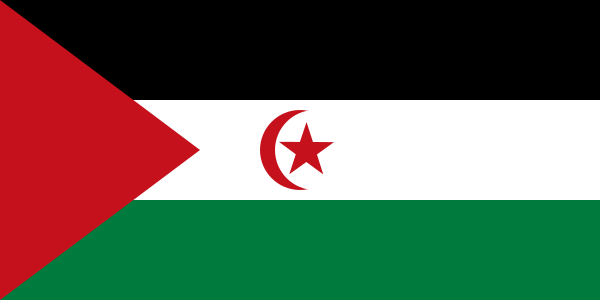
Why .eh Isn't a Real Option - Western Sahara

Why .eh Isn't a Real Option

The two-letter code .eh is reserved by ISO 3166-1 for Western Sahara and is technically listed as a country code, but IANA has never delegated it to a registry. In 2007 a consortium applied to administer .eh on behalf of the Sahrawi Arab Democratic Republic; Morocco, which controls roughly 80 percent of the territory, made a competing claim; ICANN's response was to decline delegation to either side rather than pick a winner (iana.org/domains/root/db/eh.html). Nothing has changed since. There is no registry, no accredited registrar, and no way to buy a .eh domain today, regardless of what a search result or a reseller's price list might imply.

This isn't a temporary gap waiting on paperwork — it's tied directly to the unresolved sovereignty dispute the territory has sat under since Spain withdrew in 1975. A ccTLD needs a government or recognized authority to sponsor it, and Western Sahara has two competing claimants and no settlement. Until that changes at the political level, .eh stays unassigned. Any provider offering to 'register your .eh domain' is either confused about the territory's status or selling something that doesn't exist.


What Businesses Register Instead

Companies operating from the Moroccan-administered cities — where the overwhelming majority of the territory's commercial internet activity is concentrated — register under Morocco's own ccTLD, .ma, or under a generic top-level domain such as .com or .net. Registering .ma requires a local registrar and a Moroccan administrative contact, and since 2006 the Agence Nationale de Réglementation des Télécommunications (ANRT) has been the sole authority overseeing that ccTLD (iana.org/domains/root/db/ma.html). A reseller handles that local-contact requirement as part of the registration, so the business itself doesn't need a Moroccan legal entity to get a .ma domain live.

For companies serving customers beyond the region, or whose customer base leans international, a generic domain often makes more sense than .ma regardless of where the business is physically based — a point covered in more depth further down this page. Either path is genuinely available today; a .eh domain is not, and no honest provider should be selling one.

SSL and Website Security for a Business Domain

Every business domain needs an SSL certificate to encrypt traffic between a visitor's browser and the server — without it, browsers flag the site as not secure, which kills trust before a page even loads. Hosting bundles typically fold this in rather than pricing it as an add-on.

Certificate Types and What Each One Actually Protects

A domain-validated (DV) certificate confirms only that whoever requested it controls the domain, issues in minutes, and covers the basic encryption need for most small business sites. An organization-validated (OV) certificate adds a manual check of the business's legal registration, which shows up in the certificate details and carries more weight for a company handling customer payment information. Extended-validation (EV) certificates, once common on banking sites, have largely fallen out of favor because most browsers no longer display the green address-bar treatment that made them worth the extra cost and paperwork. The relevant standard here is TLS, documented by the IETF (ietf.org/html/rfc8446), and most reputable hosting bundles now provision at least a DV certificate automatically at setup rather than leaving it as a manual step.

Per-domain SSL provisioning — issuing and renewing the certificate automatically each time a new domain or subdomain is added to the account — is one of the clearer signals of a properly run reseller setup versus a bare-bones one. Low-cost providers frequently leave certificate renewal as a manual task the customer has to remember, and a lapsed certificate produces the same browser warning as never having one at all. An account where SSL renews itself alongside the domain removes that failure point entirely.

Where Regional Setups Commonly Fall Short

Security reviews of small business sites in this region turn up the same handful of gaps repeatedly: mixed content warnings from a site that added SSL after launch but left some image or script links pointing to the old unencrypted address, admin login pages left at the default URL with no rate limiting, and WordPress installs running months behind on core or plugin updates because nobody owns that task. None of these are exotic problems, and none require enterprise-grade tooling to fix — they require someone checking on a schedule, which is exactly what a support tier with proactive monitoring is meant to catch before a customer does.

Domain privacy, sometimes called WHOIS privacy, is worth flagging separately from SSL because it's frequently confused with it. WHOIS privacy hides the registrant's personal contact details from the public domain lookup database; it has nothing to do with encrypting site traffic. A business registering a domain under an individual's name rather than a company entity should confirm privacy protection is included, since without it a home address and phone number can end up permanently searchable.

Business Email Hosting Bundled with the Domain

A business email address on the company's own domain — [email protected] rather than a free webmail account — still reads as more credible to customers and partners, and most domain hosting plans include a small number of mailboxes at no extra cost before charging per additional seat.

Mailbox Provisioning and Anti-Spam Filtering - Western Sahara

Mailbox Provisioning and Anti-Spam Filtering

Setting up business email on a hosted domain means creating mailbox records and pointing the domain's MX records at the mail server, then layering spam and virus filtering on top before anything reaches an inbox. Layered anti-spam and anti-virus filtering — checking sender reputation, scanning attachments, and flagging suspicious links before delivery — is one of the clearer differentiators between a properly managed bundle and a bare mail server with no filtering at all. Renewal reviews commonly surface a stale SPF record include that nobody remembers adding, left over from a marketing tool the business stopped using years earlier, quietly weakening the domain's email authentication in the process.

SPF, DKIM, and DMARC are the three authentication standards that tell receiving mail servers whether an email claiming to come from a given domain is legitimate, and misconfiguring any one of them is a common reason business emails land in spam folders rather than inboxes. A properly bundled hosting plan configures all three at setup rather than leaving it to the customer to research; the underlying standards are documented by the IETF for anyone who wants the technical detail (ietf.org/html/rfc7208 for SPF).

How Mobile and Desktop Access Actually Differ

Most business email hosting supports both IMAP, which syncs mail across every device and keeps a copy on the server, and POP3, which downloads mail to a single device and is largely obsolete for anyone checking email from a phone and a laptop. Mobile clients on iOS and Android connect over IMAP the same way a desktop client does, but battery and background-sync settings on mobile can delay notifications in ways that catch business owners off guard right before a client call — worth testing deliberately rather than assuming parity with desktop.

Two-factor authentication (2FA) enforcement on mailbox logins is a setting worth confirming explicitly rather than assuming is on by default, since a compromised business email account is one of the more common entry points for invoice-fraud scams targeting small companies. Enforcing 2FA at the account level, rather than leaving it optional per mailbox, closes that gap without adding meaningful friction to daily use once the initial device pairing is done.

Cloud and VPS Hosting for a Growing Site

Shared hosting works until traffic, transaction volume, or the number of installed applications outgrows what a shared server can comfortably handle. Cloud and VPS (virtual private server) hosting are the two common next steps, and they solve different problems.

The Signs Shared Hosting Has Stopped Being Enough

Shared hosting places dozens or hundreds of accounts on one physical server, splitting resources among all of them, which keeps costs low but means one neighboring site's traffic spike can slow everyone else down. The clearest sign a business has outgrown it is a site that loads noticeably slower during its own peak hours despite no recent content changes — usually a symptom of resource contention rather than anything wrong with the site itself. A second sign is hitting a shared plan's file storage or database limit while adding e-commerce functionality or a growing media library.

A third, less obvious sign is needing server-level configuration changes — a custom PHP version, a specific caching layer, a scheduled task running on its own timing — that a shared environment simply doesn't expose to individual accounts. Shared hosting is built for uniformity across every account on the box; the moment a business needs something server-specific, it's time to look at VPS or cloud.

Choosing Between Cloud and VPS

A VPS partitions one physical server into isolated virtual servers, each with a fixed, dedicated slice of CPU, memory, and storage that other accounts on the same hardware can't touch — predictable performance at a fixed monthly cost. Cloud hosting instead draws resources from a pool spread across multiple physical machines, scaling up automatically during a traffic spike and back down afterward, which suits a business with seasonal or unpredictable demand better than a fixed VPS allocation would. Storage pooling across that broader cloud infrastructure is what makes the automatic scaling possible in the first place, rather than being tied to whatever one physical machine happens to have free.

For most business websites in this region, a VPS is the more cost-predictable choice: traffic patterns tend to be steadier than an e-commerce flash sale, and a fixed monthly cost is easier to budget in MAD than a cloud bill that fluctuates with usage. Cloud hosting earns its higher and more variable cost when a business genuinely can't predict its own traffic — a seasonal tourism operator or a company running a time-limited online promotion, for instance.

Expert Hosting Guidance

Get the Right Hosting Tier Without Guessing

Whether shared hosting is still enough or the site has already outgrown it, Niya Digital's team can review current traffic and storage patterns and recommend the right tier before an upgrade becomes an emergency. As an Authorized Partner, Niya Digital handles the sizing conversation and the migration in one call — no separate vendor for advice and setup.

Why speak with Niya Digital?

Get a hosting plan based on real requirements.

Review your current hosting and resource usage

Recommend a hosting tier matched to actual demand

Get migration support when a change is needed

Trusted Reseller & Authorized Partner

Enterprise-Grade Hosting and Redundancy

Enterprise domain hosting adds the infrastructure and access controls a growing business needs once downtime or a compromised admin account has a real financial cost — redundant server architecture, tighter access enforcement, and a support tier built for faster response.

Redundant Architecture and What Failover Actually Means - Western Sahara

Redundant Architecture and What Failover Actually Means

Redundant data center architecture means the hosting provider's infrastructure runs across more than one physical facility or power and network path, so a single hardware failure, power outage, or fiber cut in one location doesn't take a customer's site offline. Failover is the automated process of shifting traffic to the working facility when the primary one has a problem, ideally happening fast enough that visitors never notice. Most reputable providers in this category target minimal disruption during a failover event, though exact figures vary by provider and plan tier and are worth confirming directly rather than assuming.

This level of redundancy matters more, not less, for a business operating in a territory with a single, less mature domestic internet backbone — a local outage here has fewer alternate routes to fall back on than it would in a market with denser infrastructure. Hosting the actual server infrastructure outside the territory, in a facility with genuine redundancy, is a deliberate design choice for that reason, not a compromise.

2FA and Access Control on Admin Panels

Two-factor authentication enforcement on the hosting control panel — not just on the email account covered earlier — closes off the single most common way a hosting account gets compromised: a reused or guessed password with no second check behind it. Enforcing 2FA at the account level rather than leaving it as an optional toggle removes the temptation to skip it during a busy setup, which is when it most often gets left off. Role-based access is the second piece: giving a contractor or junior staff member a login limited to file management, without full billing or domain-transfer authority, contains the damage if that one login is ever compromised.

Reviews of compromised small-business hosting accounts turn up the same root cause more often than any other: a single shared login used by everyone on the team, with no individual accountability for who made a given change. Splitting access by role isn't just a security best practice on paper — it's the difference between tracing an unauthorized change to one person in minutes versus not being able to trace it at all.

What Domain Hosting Costs for a Business Here

Pricing for domain and hosting bundles varies by storage, mailbox count, and support tier, and figures below are approximate ranges in Moroccan dirhams (MAD) rather than fixed quotes — confirm current pricing directly with a provider before budgeting against it.

What Typically Drives the Price Up or Down

Entry-level shared hosting bundles for a small business site with a handful of mailboxes generally sit at the lower end of the market, with cost rising as storage, mailbox count, and included SSL or backup features increase. VPS and cloud plans cost meaningfully more than shared hosting because the business is paying for dedicated or scalable resources rather than a slice of a shared server, and enterprise tiers with redundant infrastructure and priority support sit above that again. Domain registration itself is typically the smallest line item in the bundle, with the hosting and email components accounting for most of the recurring cost.

Priority support tiers are a common lever providers use to differentiate otherwise similar plans — faster guaranteed response times, a named account contact, or phone support instead of ticket-only — and that tier difference often explains a price gap between two plans with near-identical technical specifications. A business deciding between two similarly priced options should weigh what happens when something breaks at 6pm on a Friday, not just the storage figures on the comparison page.

VAT and What to Expect on the Invoice

Businesses purchasing hosting services delivered to or consumed within Morocco's tax jurisdiction should expect VAT-compliant invoicing at the applicable rate — Morocco's standard VAT rate sits at 20 percent as of the 2026 reform that consolidated the country's rate structure, with a reduced 10 percent rate applying to a narrower set of goods and services (most standard hosting and domain services fall under the standard rate). A properly issued invoice separates the VAT line from the service cost rather than folding it into a single figure, which matters for a business reclaiming input VAT on its own filings.

Reseller pricing displayed as an approximate range rather than a fixed number reflects genuine variability — currency movement, plan customization, and add-ons all shift the final figure — and any provider quoting an exact fixed price without first confirming plan details and mailbox count is skipping a step that affects the real invoice total.

Migrating a Website Without Downtime

Moving a site from one hosting provider to another, or changing which server a domain points to, carries real downtime risk if the DNS cutover isn't sequenced correctly — the site can go dark for hours or serve the wrong content to visitors who hit a not-yet-updated DNS record.

DNS Propagation and Planning the Cutover Window

DNS propagation is the delay between updating a domain's DNS records and every resolver worldwide picking up that change, driven mostly by the time-to-live (TTL) value set on the record and by how aggressively different internet service providers cache DNS lookups. Lowering the TTL on the relevant records 24 to 48 hours before a planned migration shortens that propagation window considerably, and skipping this step is the single most common reason a migration causes more visible downtime than it needed to. Businesses on a slower regional connection with fewer local DNS resolvers sometimes see propagation lag slightly longer than global averages, which is worth building into the cutover schedule rather than assuming a clean, instant switch.

The safest sequence keeps the old hosting account fully live and untouched while the new one is built and tested in parallel, only updating the DNS record to point at the new server once everything on it has been verified working. Tearing down the old account before confirming the new one is fully functional is the mistake that turns a routine migration into an actual outage.

What a Migration Concierge Actually Does

Migration concierge service means the provider's team handles the technical transfer directly — moving files, databases, and email — rather than leaving the business to export and re-import everything itself. For a team without a dedicated IT specialist, that hands-on handling is often the difference between a same-day cutover and a project that drags on for weeks around everyone's other responsibilities. It typically covers the site files and database, DNS record updates, and re-pointing email, but a business should confirm upfront whether historical email is included in the move or needs a separate export.

A concierge migration doesn't remove the value of testing the new environment before the final cutover — checking that forms submit correctly, that the SSL certificate is live, and that email is actually receiving mail on the new server, all before the old account is switched off. Skipping that verification step to save a day of overlap is a common shortcut that occasionally costs far more than the day it saved.

Comparing Domain Hosting Providers Serving This Region

Providers serving businesses here range from bare-bones global registrars with no regional context to full-service resellers who handle local registration requirements, invoicing, and support directly — the difference shows up most clearly once something needs fixing.

What Separates a Reseller from a Low-Cost Alternative

A low-cost global registrar sells a domain and a hosting slot with minimal support beyond a ticket queue, no awareness of local registration requirements for .ma domains, and no MAD-based invoicing — leaving the business to sort out currency conversion and VAT documentation itself. A reseller working this market directly handles the local administrative contact requirement for .ma registrations, invoices in MAD with proper VAT treatment, and typically staffs support with people who've solved the same regional connectivity and propagation quirks before. Reseller-managed provisioning speed — how quickly a new mailbox, subdomain, or SSL certificate actually goes live after being requested — is one of the more concrete ways to compare providers, since it reflects how much of the process is automated versus manually queued.

The trade-off is usually a modest price premium over the cheapest global option, in exchange for support that actually understands the setup being supported. For a business without in-house IT depth, that premium is frequently the cheaper outcome once the cost of unresolved downtime or a mishandled migration is factored in.

Plan Tier Comparison

Approximate feature breakdown across common bundle tiers. Figures are ranges, not fixed offers, and should be confirmed directly with a provider.

FeatureStarterBusinessEnterprise
StorageUp to 10 GBUp to 50 GB100 GB or more, scalable
Mailboxes included210Unlimited on most plans
SSL certificate typeDV, auto-renewedDV or OVOV, with per-subdomain provisioning
Backup frequencyWeeklyDailyDaily with off-site copy
Support channelTicket onlyTicket plus phoneNamed account contact
Server architectureShared serverVPS availableRedundant multi-facility
Migration assistanceSelf-service guideConcierge on requestConcierge included
2FA enforcementOptionalRecommended, togglableEnforced account-wide
Domain privacy (WHOIS)Add-onIncludedIncluded
Typical fitSingle-page or small brochure siteActive business site with email at scaleMulti-site or transaction-heavy operation

Choosing .ma, .com, or Another Generic Domain

With .eh off the table, the real decision is between Morocco's .ma and a generic option like .com — and the right answer depends more on who the business is actually selling to than on where it's physically based.

Local Registrar Requirements Under ANRT - Western Sahara

Local Registrar Requirements Under ANRT

Registering a .ma domain requires going through a registrar with a Moroccan administrative contact, a requirement ANRT has enforced as the sole delegated authority over the ccTLD since 2006 (iana.org/domains/root/db/ma.html). Additional restrictions apply to specific second-level variants such as .co.ma or .net.ma, which carry their own eligibility rules beyond the base .ma requirement. A reseller handling the registration on the business's behalf satisfies the local-contact requirement without the business needing to establish a separate Moroccan legal entity solely for domain purposes.

A .ma domain signals a Moroccan or Morocco-administered-territory connection clearly to local visitors and search engines, which helps with local search visibility for a business whose customers are primarily searching from within the region. It's a smaller, more specialized namespace than .com, which also means slightly less domain-squatting competition for a desirable business name.

When a Generic Domain Outperforms a Country Code

A business selling to customers outside the region — an exporter, a services company with international clients, or a company where most inbound traffic comes from outside Morocco or the wider Maghreb — is generally better served by .com or another generic top-level domain, since it carries no geographic association that might read as a limitation to an outside buyer. Country-code domains also introduce a small extra layer of registrar dependency that a business exporting mainly to European or North American clients sometimes prefers to avoid, particularly given the political sensitivity attached to territorial designations in this specific region.

There's no rule against holding both: many businesses here register the .com as their primary public-facing domain while holding the matching .ma as a defensive registration, redirecting one to the other. That combination costs little relative to the protection it provides against a competitor or unrelated party registering the country-code equivalent of an established brand name.

Work With a Partner Who Understands This Region

Niya Digital operates as an Authorized Partner and Trusted Reseller, handling .ma registration requirements, MAD invoicing, and migration support directly rather than leaving a business to navigate registrar rules and VAT documentation alone. Reach out for a plan recommendation suited to where the business actually sells.

Ready to get started?

Register your domain, launch your website, and build a secure digital presence with trusted hosting and expert support.

20+

Years

50,000+

Domains

24/7

Support

Frequently Asked Questions

No. The .eh code is reserved for Western Sahara under ISO 3166-1, but IANA has never delegated it to a registry, and there is no accredited registrar anywhere that can sell one. This stems from the unresolved dispute over the territory's sovereignty; a 2007 bid to administer .eh was declined by ICANN because of competing claims. Any offer to register a .eh domain today is not a genuine service. Businesses here register instead under Morocco's .ma ccTLD or a generic domain such as .com, both of which are fully available and routinely used by companies operating in the territory.

Providers serving businesses in the Moroccan-administered part of Western Sahara typically invoice in Moroccan dirhams (MAD), since that's the currency in active use across the territory's administered commercial centers. Invoices should show VAT separately from the service charge at the applicable rate — 20 percent standard, with a 10 percent reduced rate applying to a narrower set of services — rather than folding tax into a single bundled figure. A business should confirm currency and VAT treatment with a provider before committing, since some global registrars bill in USD or EUR regardless of where the customer is based.

A well-planned migration with DNS time-to-live values lowered 24 to 48 hours in advance can often complete the visible cutover within a few hours once the new environment is tested and verified. The larger factor is DNS propagation delay, which depends on caching behavior at individual internet service providers and can run slightly longer on regional connections with fewer local resolvers. The safest approach keeps the old hosting account live until the new one is fully confirmed working, which adds a short overlap period but removes the risk of an actual outage during the switch.

Email access is largely consistent across devices when the account uses IMAP, which syncs mail and folder structure across every connected device rather than downloading to just one. The practical difference is in notification timing: mobile operating systems apply battery-saving background-sync limits that can delay push notifications for new mail, which isn't a hosting-side issue but is worth testing on the actual devices staff will use daily. Website admin panels generally remain accessible from a mobile browser, though heavier management tasks like bulk file uploads are more practical from a desktop.

Shared hosting places many accounts on one physical server sharing the same pool of resources, keeping cost low but meaning a neighboring account's traffic spike can slow your own site. A VPS partitions a server into isolated virtual machines, each with a fixed, dedicated share of CPU and memory that other accounts can't consume, giving more predictable performance at a higher fixed cost. A site that slows noticeably during its own peak hours despite no content changes, or that needs a server-level configuration a shared plan doesn't expose, has typically outgrown shared hosting and is ready for VPS.

This varies by plan tier and provider, which is why it's worth confirming before purchase rather than assuming. Domain privacy, also called WHOIS privacy, hides a registrant's personal contact details from the public WHOIS lookup database; without it, a name, address, and phone number used at registration become permanently searchable by anyone. Entry-level plans sometimes sell this as a paid add-on, while mid-tier and higher bundles more commonly include it by default. It has no connection to SSL or site-traffic encryption, despite the two sometimes being confused.

Yes, and it's a common setup here. A business often uses .com as its primary public-facing domain for broader international credibility while holding the matching .ma registration as a defensive purchase, redirecting one to the other so a competitor or unrelated party can't register the country-code equivalent of an established name. The added cost is limited to one extra domain registration and, if needed, its own SSL certificate, and both can typically be managed through a single reseller account rather than two separate providers.

An expired SSL certificate causes every major browser to show visitors a security warning before the site loads, which drives away most traffic within seconds regardless of how legitimate the underlying business actually is. This is different from a mixed-content warning, which happens when SSL is active but some page elements still load over an unencrypted connection. Bundled hosting plans that auto-renew certificates alongside the domain avoid this entirely; plans that leave certificate renewal as a manual step are the more common source of this problem, particularly on accounts nobody actively monitors.

Not directly. A .ma registration requires a Moroccan administrative contact under ANRT's rules, but a reseller handling the registration typically satisfies that requirement on the business's behalf, meaning the business itself doesn't need to establish a separate Moroccan legal entity purely to hold the domain. This differs from some business licensing or banking requirements in the territory, which may have their own separate local-presence rules unrelated to domain registration specifically. Confirm the exact registration path with the provider handling the purchase, since requirements can be applied slightly differently between registrars.

An optional two-factor authentication setting is, in practice, frequently skipped during setup and never revisited, which leaves the account protected by password alone — the most common single point of failure behind compromised hosting and email accounts. Enforcing it account-wide at setup removes that gap without meaningfully slowing daily use once the initial device pairing is complete, typically a one-time process taking a few minutes per user. This applies separately to the hosting control panel and to email logins, and both should be enforced rather than assuming one covers the other.

Case Studies

Consumer ServicesInternationalized Domain Names (IDN) & Localization

A consumer services business expanding into new markets — including a push into Nigeria's local-language search and communications landscape — wanted its domain strategy to genuinely support local-language audiences, rather than relying on...

Read More about Internationalized Domain Names for Local-Market Reach

Key Takeaways

There is no working .eh domain for Western Sahara — IANA has never delegated it, and any provider selling one isn't offering a real service.

Businesses operating here register instead under Morocco's .ma ccTLD (via a reseller satisfying the local-contact requirement) or a generic domain such as .com.

Bundled domain, hosting, and email plans reduce the renewal and support overhead that trips up lean regional teams running without dedicated IT staff.

Redundant, multi-facility hosting infrastructure matters more here given the territory's less mature domestic internet backbone, not less.

Pricing should be quoted in MAD with VAT shown separately at the applicable rate — 20 percent standard as of the 2026 reform — never as a bundled, unstated figure.

A .com paired with a defensive .ma registration is a common, low-cost way to cover both local search visibility and international credibility.

Customer Success Stories

From startups and e-commerce businesses to financial platforms and global enterprises, organizations across different industries rely on dependable domain registration, hosting, DNS management, and security services to support business growth and protect their online presence.

"We were three weeks from launch and treating domain registration as an afterthought — grab the name, move on. The team walked us through variant registrations and locking before we'd even considered them. Two years later, we've never had a brand-protection scramble, which is exactly what we were told to expect but didn't fully appreciate until we saw the alternative play out with a competitor."

Marcus Whitfield

Co-Founder

Technology Startup

United StatesDomain Registration

"Our domains were expiring on five different schedules across three different staff inboxes before we brought everything under one renewal system. It's not glamorous work, but knowing our storefront and support portal can't accidentally lapse has removed a risk I used to lose sleep over during peak season."

Sarah Bouchard

Director of IT Operations

Online Retail Company

CanadaDomain Renewal

"We'd grown into a mess of registrar logins across departments and needed to consolidate without touching our live website or email. The transfer was scoped tightly, monitored domain by domain, and we didn't experience a single hour of disruption. That discipline around scope is what I'd recommend to any firm considering the same move."

James Okafor-Reid

Head of Technology

Professional Services Firm

United KingdomDomain Transfer

"Our DNS zone had become tribal knowledge spread across half a dozen engineers, and it showed every time someone made a change without knowing what it touched. Having every record documented and mapped to the service it supports has taken a genuine source of operational risk off the table."

Lena Vogt

VP of Engineering

B2B Software Company

GermanyDNS Management

"For a platform processing customer transactions, we needed to show auditors exactly who could change production DNS and why. The access controls and change logging we put in place turned what used to be an uncomfortable audit conversation into a straightforward one."

Rachel Tan

Chief Information Security Officer

Financial Technology Platform

SingaporeDNS Management (Compliance)

"We'd been treating our domain and our web host as the same thing for years, which made every infrastructure decision feel bigger than it needed to be. Separating DNS hosting from web hosting meant our last platform migration was a contained, unremarkable change instead of the ordeal our earlier moves had been."

Daniel Foster

Head of Infrastructure

Digital Commerce Business

AustraliaDomain Hosting

"Within weeks of registering my domain, I was fielding calls and emails clearly sourced from public WHOIS data. Enabling privacy protection while keeping our actual registrant details accurate solved the problem properly, rather than the workaround of submitting false information that I'd seen other small business owners resort to."

Priya Raghunathan

Founder

Independent Online Business

IndiaWHOIS Privacy Protection

"We wanted a specific domain that was approaching expiration but didn't want an engineer manually checking its status every few days. Having the lifecycle monitored systematically, with our budget and criteria agreed upfront, meant we were ready to act the moment it became available instead of reacting under pressure."

Kenji Matsuda

Product Lead

Consumer Technology Company

JapanDomain Backorder / Expired-Domain Acquisition

"Auction environments are designed to make you overpay for scarcity. Having a defined evaluation checklist — brand fit, trademark screening, total cost, and a hard bid ceiling — kept our decision grounded in what the domain was actually worth to us, not what the bidding pressure made it feel worth in the moment."

Fatima Al-Suwaidi

Chief Marketing Officer

Online Retail Company

United Arab EmiratesDomain Auction Advisory

"We were launching several properties at once, and I was far more worried about what would happen a year later than about the registrations themselves. Every domain came with a named owner and a documented purpose from day one, which meant we never ended up with the orphaned domains that plague most bulk launches."

Rafael Nogueira

Director of Digital Marketing

Digital Marketing Organization

BrazilBulk Domain Registration

"Expanding into local-language search meant our domain strategy needed to be more than a translated version of our global brand. Compatibility testing across email and DNS before we committed to our localized domains saved us from support issues we later learned other companies ran into after rolling out IDNs without that step."

Chiamaka Eze

Regional Growth Manager

Consumer Services Company

NigeriaInternationalized Domain Names & Localization

"Once we recognized that a domain compromise for us wouldn't just be a website outage but an authentication incident, we treated it accordingly — locked, access-restricted, DNSSEC-enabled, and reviewed alongside our other security controls. It's now part of our formal security architecture review, not a separate IT checklist item."

Willem de Groot

Chief Technology Officer

Financial Technology Platform

NetherlandsDomain Security

"Our biggest exposure was never fraud — it was the idea of a hijacked domain publishing something under our name before we could even respond. The DNS monitoring and dedicated incident-response path we now have means we'd catch that in minutes, not hours, which for a publisher is the entire difference."

Naledi Dlamini

Head of Digital

Media & Publishing Organization

South AfricaDomain Security (Media & Brand Protection)

"Every new market we entered brought its own small wave of domain decisions, and eventually nobody could tell you what we actually owned. Building a single inventory with clear ownership and consistent controls turned an invisible governance gap into something we can now manage deliberately as we keep expanding."

Minh Tran

Regional Operations Director

Digital Commerce Business

VietnamDomain Portfolio Management

"We didn't realize how much client-facing email was quietly landing in spam until we looked closely at our SPF and DKIM configuration across our domains. Rebuilding our authentication properly, rather than patching it domain by domain as complaints came in, made a measurable difference in what our clients actually saw land in their inbox."

Isabela Cruz

Director of Client Services

B2B Professional Services Firm

PhilippinesEmail Hosting & Deliverability

Glossary

Quickly understand the technical terms used throughout this guide. Search any keyword below to find its definition.

ccTLD

Country-code top-level domain — a two-letter domain extension (like .ma or .eh) assigned by IANA to represent a specific country or territory.

DNS propagation

The delay between updating a domain's DNS records and every resolver worldwide picking up the change, influenced by the record's TTL and by caching behavior at individual internet providers.

DV / OV / EV certificate

The three validation levels for SSL certificates — domain-validated, organization-validated, and extended-validation — differing in how thoroughly the certificate authority verifies the requester's identity.

IMAP / POP3

Two email retrieval protocols. IMAP syncs mail and folders across every connected device; POP3 downloads mail to a single device and has largely fallen out of use for multi-device access.

MX record

A DNS record that tells the internet which mail server should receive email sent to a given domain.

SPF / DKIM / DMARC

Three email authentication standards that let receiving mail servers verify whether an email claiming to be from a given domain is legitimate, reducing spoofing and improving inbox delivery.

TTL (time-to-live)

A value set on a DNS record controlling how long resolvers cache it before checking for updates; lowering it before a migration speeds up propagation of the change.

VPS

Virtual private server — a physical server partitioned into isolated virtual machines, each with a fixed, dedicated share of CPU, memory, and storage.

WHOIS privacy

A service that hides a domain registrant's personal contact details from the public WHOIS lookup database; unrelated to SSL or traffic encryption.

2FA

Two-factor authentication — a login process requiring a second verification step beyond a password, typically a code from a phone or authenticator app.

Authoritative Resources

Discover reliable information about domain names, DNS, and country-code top-level domains (ccTLDs) from trusted organizations, official registries, and global authorities.

IANA - Root Zone Database

https://www.iana.org/domains/root/db

ICANN - Domain Name Registration Information

https://www.icann.org

.eh ccTLD - Wikipedia

https://en.wikipedia.org/wiki/.eh

About the Author

Niya Digital Team

The Niya Digital Team is a team of domain and web infrastructure specialists focused on helping individuals and businesses manage their online presence with confidence. Our expertise covers domain registration, transfers, DNS management, domain security, and portfolio management. We research industry updates, follow registrar policies and best practices, and publish clear, practical guides that are regularly reviewed for accuracy and updated to reflect changes in the domain industry. Learn more about our editorial team and standards at Niya Digital.

;
Facebook
X
LinkedIn
WhatsApp
Telegram
Pinterest