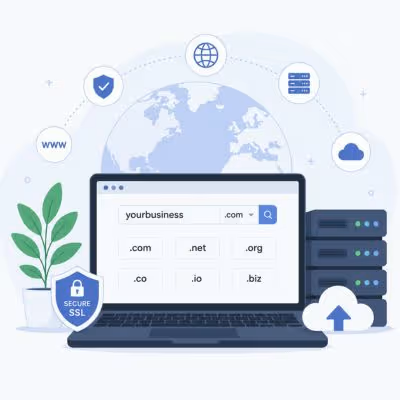
DNS (Domain Name System)
The system that translates a domain name into the server address a browser needs to load a website or route email.
Nameserver
A server that holds a domain's DNS records and tells the internet where to send traffic for that domain.
SSL Certificate
A file that enables encrypted communication between a visitor's browser and a website's server, shown to visitors as a padlock icon.
cPanel
A web-based control panel used to manage hosting accounts, including email, files, databases, and DNS records.
VPS (Virtual Private Server)
A hosting environment that partitions a physical server into isolated virtual machines, each with guaranteed dedicated resources.
Cloud Hosting
Hosting that distributes a website's resources across multiple servers, allowing capacity to scale automatically and traffic to reroute if one server fails.
Shared Hosting
A hosting arrangement where multiple websites share the resources of one physical server, typically at a lower cost but with less resource isolation.
Generic-Style ccTLD
A country-code top-level domain, such as .cc, that is administered on behalf of a specific territory but marketed and used internationally as a generic-sounding extension rather than a locally-restricted one.
External Territory (GST context)
A classification under Australian tax law under which certain territories, including the Cocos (Keeling) Islands, are excluded from the standard definition of Australia used for GST purposes.
TTL (Time to Live)
A value set on a DNS record that determines how long resolvers cache it before checking for updates.
MX Record
A DNS record that directs a domain's incoming email to the correct mail server.
SPF (Sender Policy Framework)
A DNS record that lists which mail servers are authorized to send email on behalf of a domain, reducing spoofing.
DKIM (DomainKeys Identified Mail)
An email authentication method that adds a digital signature to outgoing mail, helping receiving servers verify it wasn't altered in transit.
DNSSEC
A set of extensions that cryptographically sign DNS records to prevent them from being spoofed or tampered with.
2FA (Two-Factor Authentication)
A login security method requiring a second verification step beyond a password, such as a code from a mobile app.
TLD (Top-Level Domain)
The final segment of a domain name, such as .com or .cc, indicating its category or country association.
ccTLD (Country-Code Top-Level Domain)
A top-level domain assigned to a specific country or territory, such as .cc for the Cocos (Keeling) Islands.
WHOIS Privacy
A service that masks a domain owner's personal contact details in the public WHOIS registration record.