
































































































































































































































Niya Digital

Domain Hosting for Business in Panama: Secure, Scalable Plans

Panamanian companies increasingly bundle domain registration with managed hosting to cut vendor overhead and keep uptime, email, and DNS under one support relationship. This page breaks down plan types, security layers, migration steps, and realistic pricing for teams choosing business-grade domain hosting over consumer-tier shared plans.

Domain Registrations @ $14.99 | Domain Renewals @ $15.99

Domain Hosting for Business in Panama

*1dollardomainhosting is owned & operated by Niya Digital.

Domain Hosting Services for Business Explained

Domain hosting for business combines a registered domain name with server space, email routing, and DNS management under a single account. For companies running a website, staff inboxes, and internal tools, that bundling removes the coordination overhead of managing a registrar and a hosting provider separately once multiple domains and mailboxes are involved.

What Domain Hosting Includes

Domain hosting services for business typically pair domain name registration with web server resources, DNS zone management, and at least one tier of business email, delivered through a single provider relationship rather than separate registrar and host accounts scattered across different billing cycles and support desks. Storage allocation, bandwidth limits, and mailbox count vary by tier, and most business packages now include a free SSL certificate and basic filtering as standard rather than a paid add-on.

Reseller-managed accounts, where a certified partner provisions and administers the underlying infrastructure on the client's behalf, tend to activate faster than direct sign-ups through a self-service registrar portal. The partner has usually pre-built DNS templates and mail routing defaults for common business scenarios, so a new domain can point to a live site and working inboxes within hours instead of the days it can take when a small IT team configures zone records from scratch. Support tickets from newly onboarded clients often trace back to a missed MX record or a nameserver that was never propagated, which a provisioning partner catches before launch.

Why Businesses Bundle Domain and Hosting

Separating a domain registrar from a hosting provider was common practice a decade ago, largely because early hosting companies offered weak domain management tools. That gap has closed. Bundling now means one invoice, one support contact, and one renewal calendar instead of two expiry dates that can drift out of sync and cause a business to lose its domain over a missed notification email that landed in a spam folder nobody checked that week.

The practical advantage shows up during incidents. If a website goes down and the domain, DNS, and hosting sit with three different vendors, diagnosing whether the problem is DNS propagation, server load, or registrar-side suspension can burn hours before anyone even reaches the right support queue. A bundled setup lets one technical contact see the domain status, DNS records, and server logs in the same dashboard, which shortens root-cause diagnosis considerably for non-enterprise IT teams without a dedicated network engineer on staff.

Business Domain Hosting for Panamanian Companies

Panama's position as a regional trade and logistics hub means many businesses here run operations across time zones, which raises the bar for uptime and support responsiveness. Domain hosting plans built for Panamanian SMEs and larger firms need to account for that operating pattern from the start.

What Panamanian Buyers Should Check Before Signing - Panama

What Panamanian Buyers Should Check Before Signing

Business domain hosting in Panama should be evaluated on data center redundancy, support hours that overlap with Panama's UTC-5 working day, and whether pricing is quoted transparently in US dollars rather than buried in a foreign currency that requires manual conversion on every invoice. A provider that cannot explain where traffic is routed during a regional outage is not ready for a company that depends on its website for order intake or client communication.

Redundant data center architecture, meaning traffic can fail over to a secondary facility if the primary one has a power or network event, matters more for businesses in logistics, import-export, and finance than for a personal blog. A single-location host with no failover plan can mean an entire afternoon of downtime during a regional connectivity issue, and for a company processing shipment documentation or client payments, that translates directly into lost revenue rather than a minor inconvenience.

ITBMS Invoicing and Local Buying Patterns

ITBMS-compliant invoicing, Panama's transfer tax on movable goods and services, is a basic expectation for any recurring business expense, including hosting subscriptions, and finance teams should confirm a provider can issue invoices that meet local documentation standards before committing to an annual plan. A provider unable to produce compliant invoices creates unnecessary friction during tax season for the accounting department.

Domain naming behavior in Panama leans heavily toward .com for public-facing brands, with .pa reserved more often for government-adjacent, legal, and locally regulated entities that want to signal Panamanian jurisdiction explicitly. A business targeting regional Central American clients alongside domestic ones frequently registers both, using the .com as the primary brand domain and the .pa as a redirect or a locally trusted variant for government tenders and local directory listings.

SSL and Website Security on Hosted Domains

A domain without a valid SSL certificate now triggers browser warnings that cost conversions before a visitor reads a single word of copy. Business hosting plans should treat certificate provisioning and renewal as an operational default, not a manual annual task.

How SSL Provisioning Works on a Hosted Domain

SSL, or Secure Sockets Layer, is the encryption protocol that secures data moving between a visitor's browser and a hosted website; in practice, most current certificates use its successor, TLS (Transport Layer Security), while the industry still refers to the certificates themselves as SSL certificates out of habit. A valid certificate encrypts form submissions, login credentials, and payment details in transit, and its absence is flagged directly in the browser address bar.

Per-domain SSL provisioning, where each domain and subdomain on an account receives its own certificate automatically rather than sharing one wildcard certificate across unrelated properties, reduces the blast radius if a certificate is ever compromised or misconfigured. Certificate authorities and browser vendors publish the governing standards through the CA/Browser Forum, whose baseline requirements documentation at cabforum.org lays out validation and renewal rules that reputable hosts follow without a customer needing to track expiry dates manually.

Security Layers Beyond the Certificate

A certificate alone does not stop a compromised WordPress plugin or a brute-force login attempt against an admin panel. Business hosting plans typically layer in a web application firewall, automated malware scanning, and IP-based rate limiting on login endpoints, and the meaningful differentiator between providers is usually how quickly a flagged file gets quarantined rather than whether scanning exists at all.

Security audits on newly migrated Panamanian business sites turn up an expired SSL renewal notice sitting unread in an inbox more often than any exotic attack vector; the practical failure mode is administrative, not technical. Teams that put certificate renewal on autopilot through their host, rather than tracking it in a spreadsheet, consistently avoid the multi-day scramble that follows a certificate lapsing during a public holiday when nobody is monitoring alerts closely.

Business Email Hosting on a Company Domain

A business email address on the company's own domain still outperforms a free webmail account for client trust, and hosting providers bundle mailbox tiers directly into domain hosting plans rather than treating email as a separate purchase.

Mailbox Provisioning and Filtering - Panama

Mailbox Provisioning and Filtering

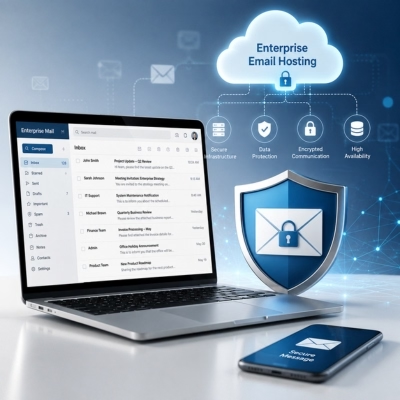
Business email hosting in Panama, bundled with domain hosting, provisions mailboxes on the company's own domain, applies spam and malware filtering before messages reach an inbox, and typically includes calendar and contact syncing across desktop and mobile clients as part of the base tier rather than a premium upgrade. Storage per mailbox varies widely between providers, so growing teams should confirm whether storage pools across the account or caps per user.

Layered anti-spam and anti-virus filtering, meaning messages pass through multiple detection engines before delivery rather than a single spam score check, catches a materially higher share of phishing attempts that specifically impersonate vendors or executives within a company, a pattern that has become common against finance and logistics firms handling wire transfers. A single-layer filter tends to miss these targeted attempts because they are crafted to avoid generic spam signatures.

Authentication Records That Prevent Spoofing

SPF (Sender Policy Framework), DKIM (DomainKeys Identified Mail), and DMARC (Domain-based Message Authentication, Reporting, and Conformance) are the DNS records that tell receiving mail servers which sources are authorized to send on a domain's behalf, and configuring all three correctly is what keeps legitimate outbound email out of recipients' spam folders. The Internet Engineering Task Force documents these standards directly, including the DKIM specification at ietf.org, which reputable hosting providers implement by default during mailbox setup.

Renewal reviews on existing Panamanian business accounts commonly surface a stale SPF include that nobody remembers adding, often left over from a marketing tool the company stopped using years earlier, which quietly weakens the domain's authentication posture without triggering any visible error. Cleaning up unused SPF includes and confirming DMARC is set to actually enforce, rather than just monitor, is a five-minute task that measurably improves inbox placement rates for outbound client communication.

Cloud and VPS Hosting for Growing Sites

Shared hosting works until traffic, transaction volume, or the number of applications running on a domain outgrows a shared server's resource limits. Cloud and VPS hosting give a business dedicated or elastically scalable resources without a full server migration project.

Shared, VPS, and Cloud Hosting Compared

VPS, or Virtual Private Server, hosting partitions a physical server into isolated virtual environments, each with guaranteed CPU, RAM, and storage that other accounts on the same hardware cannot consume, unlike shared hosting where resource limits are soft and one high-traffic neighbor can slow every site on the box. Cloud hosting takes this further by distributing a site across a pool of servers that can scale resources up or down automatically during traffic spikes.

Storage pooling, where a business's allocated disk space draws from a shared cloud pool rather than a fixed partition on one physical drive, means a sudden spike in order volume or file uploads does not hit a hard ceiling the way a fixed VPS allocation can. A logistics company running order tracking through its website during peak shipping season benefits directly from that elasticity, since traffic during a promotional push can be four or five times the daily average without warning.

When to Move Off Shared Hosting

The signal to upgrade is rarely a single dramatic outage; it is usually a pattern of slow page loads during predictable peak hours, a support ticket queue that keeps citing resource limits, or a compliance requirement that demands isolated infrastructure a shared environment cannot provide. Businesses running e-commerce, client portals, or any application handling payment data should treat VPS or cloud hosting as the baseline rather than an eventual upgrade.

Migration between tiers does not require a new domain or a DNS overhaul in most cases; a provider moves the site to new server resources and updates internal routing while keeping the domain's public-facing records unchanged, so downtime during a tier upgrade should be measured in minutes rather than hours if the provider plans the cutover properly. Businesses evaluating providers should ask specifically how tier upgrades are executed before signing, since the answer reveals a lot about operational maturity.

Expert Hosting Guidance

Get a Hosting Tier That Matches Your Traffic

If shared hosting is already straining under order volume or seasonal traffic spikes, moving to a right-sized VPS or cloud plan does not have to mean a disruptive migration. Niya Digital, an Authorized Partner for domain and hosting services, can assess current usage and recommend a tier built for actual demand.

Why speak with Niya Digital?

Get a hosting plan based on real requirements.

Review your current hosting and resource usage

Recommend a hosting tier matched to actual demand

Get migration support when a change is needed

Trusted Reseller & Authorized Partner

Enterprise and Secure Domain Hosting

Larger Panamanian organizations, particularly in banking, logistics, and legal services, need hosting arrangements built around access control and account-level security rather than raw server capacity alone. Enterprise domain hosting addresses that with stricter authentication and dedicated support paths.

What Makes a Domain Hosting Plan Enterprise-Grade - Panama

What Makes a Domain Hosting Plan Enterprise-Grade

Enterprise domain hosting typically adds role-based account access, so a marketing manager cannot accidentally alter DNS records that route production traffic, alongside audit logging that records who changed what and when across the account. Secure domain hosting at this tier also includes registry lock, a status that prevents unauthorized domain transfers or deletions even if a login credential is compromised, which matters enormously for a company whose domain is core to its brand identity.

2FA enforcement, requiring a second authentication factor beyond a password for any account login, closes off the most common account takeover path, where a reused or leaked password from an unrelated breach gets tried against a hosting or registrar login. Enterprise plans that enforce 2FA at the account level, rather than leaving it optional per user, measurably reduce successful takeover attempts compared to accounts where individual staff can opt out.

Access Control for Multi-Department Teams

Companies with separate marketing, IT, and finance stakeholders touching the same domain account need granular permissions rather than one shared login passed around by email, a pattern that still shows up surprisingly often during account audits and creates an immediate liability when an employee leaves without the password being changed. Enterprise-tier hosting accounts typically support unlimited sub-users with permission scopes tied to specific functions like billing, DNS, or email administration.

A practical test during vendor evaluation is asking a provider to demonstrate revoking a single user's access without disrupting anyone else's login or triggering a DNS change; providers still running on legacy account systems sometimes cannot do this cleanly, and a full password reset across the team becomes the only option, which is both a security gap and an operational headache during staff transitions.

Domain Hosting Pricing in Panama

Domain hosting pricing in Panama varies by plan tier, mailbox count, and whether SSL and security add-ons are bundled or billed separately. The ranges below reflect typical business-tier pricing rather than promotional first-year rates that expire at renewal.

Typical Price Ranges by Plan Tier

Domain hosting pricing for business in Panama generally runs from roughly USD 60 to USD 150 per year for entry-level shared business plans with a handful of mailboxes, climbing to an approximate USD 200 to USD 600 annual range for VPS-tier hosting with dedicated resources, and higher still for enterprise and cloud configurations sized to specific traffic and storage needs. These figures are indicative ranges, not fixed offer pricing, and should be confirmed directly against a current quote before budgeting.

Priority support tiers, where a business account gets a dedicated response-time commitment rather than sitting in a general queue, typically add a modest premium to the base plan cost but shorten incident resolution time considerably during an outage. For a company where the website drives direct revenue, that premium tends to pay for itself the first time a priority ticket gets a same-hour response instead of a next-business-day one.

Budgeting for Renewal Cycles

As Panamanian businesses move into their 2026 budget planning cycles, finance teams renewing multi-year domain and hosting contracts should compare the renewal rate against the introductory rate quoted at signup, since promotional first-year pricing on both domains and hosting plans commonly steps up at the second renewal. Locking a multi-year term can hedge against that increase, but only if the contract terms are read carefully for early-termination clauses.

ITBMS-compliant invoicing, covered earlier for its documentation requirements, also affects effective budgeting since the tax adds to the quoted subscription price rather than being included in most published rate cards; finance teams should request an all-in quote that shows the tax line separately rather than estimating it after the fact, which avoids a recurring monthly reconciliation headache for the accounting team.

Website Migration and DNS Setup

Moving a live business website to a new host is where most avoidable downtime happens, almost always due to DNS propagation timing rather than the actual file transfer. A structured migration plan keeps a domain's email and website live throughout the switch.

How DNS Hosting Controls Where Traffic Goes

DNS (Domain Name System) hosting is the service that translates a domain name into the server addresses browsers and mail clients actually connect to, through records including A records for website IP addresses, MX records for mail routing, and CNAME records for subdomains and third-party service integrations. Changing a nameserver or a key record does not take effect instantly; propagation across the global DNS network typically completes within a few hours but can occasionally take up to 48 hours depending on cached record lifetimes.

A migration concierge service, where the receiving host's team plans the DNS cutover sequence and monitors propagation rather than leaving a client to change records and hope for the best, is what separates a clean migration from one that drops email for a business's entire staff mid-week. The sequencing matters: lowering a record's time-to-live value days before the actual cutover shortens the propagation window when the real change happens.

A Practical Migration Checklist

Migration reviews for Panamanian business clients consistently turn up one missed step: nobody exported the existing email account list and custom DNS records before initiating the transfer, which turns a planned same-day cutover into a multi-day reconstruction effort chasing down settings from memory. A written inventory of every DNS record, mailbox, and connected third-party service, taken before touching anything, is the single highest-leverage step in the entire process.

The general sequence that avoids downtime: lower TTL values a few days ahead, copy the website files and database to the new host without changing DNS yet, verify the site loads correctly on a temporary preview URL, migrate mailboxes and confirm mail flow on the new server, and only then update the nameservers or key records to point traffic to the new environment, followed by a 48-hour monitoring window before decommissioning the old account.

Choosing a Domain Hosting Provider in Panama

Comparing domain hosting providers in Panama on price alone misses the factors that actually determine whether a business avoids downtime and support delays. A structured comparison across support, infrastructure, and contract terms gives a clearer picture.

What Separates a Reliable Provider From a Budget One

The best domain hosting for business in Panama generally comes from a provider offering a dedicated hosting infrastructure tier for business accounts, meaning business customers are not sharing server capacity with high-churn personal-plan sign-ups that create unpredictable load spikes. Mobile versus native client behavior for business email is another frequently overlooked comparison point: some providers' mobile sync lags noticeably behind desktop clients, which matters for staff managing client communication from a phone between meetings.

Contract flexibility deserves as much scrutiny as the feature list. A provider locking a business into a multi-year term with no defined migration-assistance clause if the relationship ends creates real switching costs later, whereas a provider that documents its own data-export and migration-out process signals confidence in its service rather than reliance on lock-in to retain customers.

Comparing Domain Hosting Providers for Business

Beyond feature lists, a useful comparison looks at how a provider handles the account when something goes wrong outside normal business hours, since that is when a business actually discovers whether a support commitment was real or marketing copy. Asking for an average incident response time, not just a stated SLA target, and checking whether that number is reported publicly or only quoted verbally during a sales call, separates providers confident in their track record from those hoping the question doesn't come up.

Domain hosting provider comparisons should also weigh how upgrades between tiers are priced, since some providers structure pricing so that moving from shared to VPS hosting effectively doubles the bill for marginal resource gains, while others price tier upgrades closer to the actual infrastructure cost difference. Requesting a full price ladder across all tiers before committing to an entry-level plan avoids an unpleasant surprise the first time the business needs to scale up.

Business Domain Hosting Comparison by Plan Tier

A side-by-side view of what typically changes across shared, VPS, cloud, and enterprise business hosting tiers.

Plan TierTypical Mailbox AllowanceResource ModelSupport Response Target
Shared business5-25 mailboxesShared server capacityNext business day
VPS business25-100 mailboxesGuaranteed CPU/RAM allocationSame business day
Cloud business50-250 mailboxesElastic, auto-scaling poolPriority queue, hours
Enterprise250+ mailboxesDedicated infrastructure tierDedicated response SLA
Shared businessRegistry lockNot typically availableOptional add-on
VPS businessRegistry lockAvailable as add-onIncluded on some plans
Cloud business2FA enforcementOptional per userRecommended, not forced
Enterprise2FA enforcementEnforced account-wideStandard inclusion
Shared businessMigration conciergeSelf-service tools onlyNot included
EnterpriseMigration conciergeAssigned migration teamIncluded on onboarding

.pa Domain Hosting for Panamanian SMEs

Panamanian small and mid-sized businesses weighing a .pa registration alongside or instead of .com should understand what the domain signals to local clients, government portals, and search visibility within the country before deciding.

When .pa Makes Sense for a Business - Panama

When .pa Makes Sense for a Business

Registering a .pa domain for hosting for Panamanian SMEs signals local jurisdiction clearly, which matters for businesses bidding on government contracts, operating in regulated sectors like finance or legal services, or targeting search visibility specifically within Panama over a broader Central American or international audience. A construction firm or law office serving primarily Panamanian clients often sees a measurable local-search benefit from a .pa domain that a generic .com does not deliver on its own.

Registering .pa domain hosting alongside an existing .com is a common defensive move for established brands, protecting the name from being registered by a competitor or a squatter while the business continues operating primarily under its .com identity. Redirecting the .pa variant to the primary site preserves the brand without requiring a second, fully built-out website to maintain.

Registration Requirements and Practical Steps

ICANN's registrant documentation, available through icann.org, outlines the general accreditation and WHOIS obligations that apply to country-code domains globally, though .pa registration specifically runs through Panama's designated country-code registry rather than a generic ICANN-accredited registrar for .com-style domains, which is a distinction worth confirming with a provider before assuming identical registration steps apply. Business registrants should have their local business registration documentation ready, since .pa registration commonly requires it.

Hosting for Panamanian startups choosing between .com and .pa at launch should weigh long-term brand plans over short-term cost, since switching a primary domain after a business has built search rankings and inbound links under one extension is a slower, riskier process than deciding correctly at registration. A startup planning regional expansion beyond Panama typically anchors its brand on .com and treats .pa as a secondary, locally trusted asset from day one.

Register and Host Your .pa or .com Domain

Whether the priority is local trust through a .pa registration or a broader regional presence under .com, getting the domain, DNS, and hosting set up correctly the first time avoids costly rework later. Niya Digital, a Trusted Reseller and Certified Sales Partner, can walk through the right setup for your business.

Ready to get started?

Register your domain, launch your website, and build a secure digital presence with trusted hosting and expert support.

20+

Years

50,000+

Domains

24/7

Support

Frequently Asked Questions

Entry-level business domain hosting plans in Panama typically run from around USD 60 to USD 150 per year for shared hosting with a small number of mailboxes, while VPS-tier plans with dedicated resources generally fall between roughly USD 200 and USD 600 annually. Cloud and enterprise pricing scales further based on storage, mailbox count, and support tier. These are indicative ranges rather than fixed offer prices, and providers commonly quote a lower introductory rate for the first year that steps up at renewal, so it's worth confirming the renewal price at signup rather than only the first-year quote. Invoices should also show ITBMS separately rather than folded silently into a rounded total, which makes reconciling the expense against tax records simpler for the finance team handling the annual close.

Yes, if the migration is sequenced correctly. The general approach lowers the DNS time-to-live value a few days before the cutover, copies website files and mailboxes to the new server while the old DNS records are still live, verifies everything works on a temporary preview address, and only then updates the nameservers or MX records to point to the new host. Done this way, downtime is typically limited to a short propagation window rather than hours. The most common cause of lost email during a migration is not exporting the existing mailbox and forwarding-rule configuration before starting, which turns a same-day move into a multi-day reconstruction from memory.

It's not strictly necessary, since a .com domain works fine for most Panamanian businesses and remains the default choice for companies with regional or international ambitions. A .pa registration becomes genuinely useful for businesses bidding on government contracts, operating in a regulated sector like finance or legal services, or specifically prioritizing local search visibility over broader reach. Many established businesses register both, using .com as the primary brand domain and redirecting the .pa variant to it, which protects the name from being claimed by someone else without requiring a second website to be built and maintained.

Shared hosting places a website on a server alongside many other unrelated accounts, with resource limits that are soft and can be affected by a high-traffic neighbor on the same hardware. VPS hosting partitions a server into isolated environments with guaranteed CPU and RAM that other accounts cannot consume, giving more predictable performance. Cloud hosting distributes a site across a pool of servers that scale resources automatically during traffic spikes, which suits businesses with seasonal or unpredictable demand, such as e-commerce sites during promotional periods. The right choice depends on traffic predictability and whether the business can tolerate a hard resource ceiling during a busy period.

Most current business domain hosting plans include at least a basic SSL certificate as a standard inclusion rather than a paid add-on, since browsers now flag unencrypted sites directly to visitors, which providers have responded to by making certificates default. Higher tiers often provision a separate certificate per subdomain automatically, rather than sharing one certificate across unrelated properties, which limits exposure if a single certificate is ever compromised. It's still worth confirming during a provider comparison whether renewal is automatic, since a lapsed certificate that nobody catches for a few days is a more common failure than any external attack on a properly configured account.

Mailbox allowances scale with plan tier rather than being unlimited on entry-level plans. Shared business hosting plans commonly allow somewhere between five and twenty-five mailboxes, VPS plans extend into the dozens, and cloud or enterprise tiers can support hundreds of mailboxes with storage drawn from a shared pool rather than a fixed per-user cap. Businesses expecting rapid headcount growth should confirm whether adding mailboxes beyond the plan's base allowance incurs a per-mailbox fee or requires an upgrade to the next tier entirely, since that affects the real cost of scaling the team.

When a domain registrar and hosting provider are separate, mismatched renewal dates are a common cause of accidental downtime, since a missed domain renewal notice can result in the domain expiring even while hosting remains active and paid up, or vice versa. Bundling domain and hosting under one provider typically aligns both under a single renewal date and a single reminder sequence, removing that risk. If renewal dates are currently split across vendors, it's worth requesting a renewal-date alignment during the next migration rather than tracking two separate expiry calendars manually.

Yes, business email hosted on a domain typically syncs across desktop and mobile clients through standard protocols, and most hosting control panels have a mobile-accessible dashboard for basic tasks like checking DNS status or restarting a service. Sync behavior between mobile and native desktop clients isn't always identical across providers, though; some mobile apps lag behind desktop in how quickly new mail or calendar changes appear, which is worth testing directly during a trial period if staff manage client communication heavily from phones between meetings rather than from a desk.

Beyond an SSL certificate, business-grade hosting should include a web application firewall filtering malicious requests before they reach the server, automated malware scanning of hosted files, rate limiting on login attempts to slow brute-force attacks, and ideally two-factor authentication enforced at the account level rather than left optional per user. Enterprise tiers often add registry lock, which prevents a domain from being transferred or deleted even if a login credential is compromised. The practical differentiator between providers is usually response speed once a threat is flagged, not whether these protections exist at all, since most reputable hosts now include some version of each.

For a standard business website and a modest number of mailboxes, a well-planned migration with a migration concierge team typically completes the technical cutover within a single day, with DNS propagation adding up to another 24 to 48 hours before every visitor and mail server worldwide reflects the change consistently. Larger sites with custom applications, extensive email history, or complex third-party integrations can take longer, particularly if data needs validation after transfer. Scheduling the cutover for a lower-traffic period, such as a weekend, and keeping the old hosting account active during the propagation window as a fallback are standard precautions that limit business disruption.

Case Studies

Digital Commerce & ServicesDomain Hosting

A digital commerce business operated a customer-facing website, a transactional platform, corporate email, and several supporting web services. Like many growing companies, the team treated domain hosting and web hosting as functionally ide...

Read More about Domain Hosting and the DNS-vs-Web-Hosting Distinction

Key Takeaways

Bundling domain registration with hosting consolidates DNS, email, and website management under one support relationship, reducing the diagnostic time when something breaks.

Panamanian businesses should confirm redundant data center architecture, USD pricing transparency, and ITBMS-compliant invoicing before committing to a provider.

Per-domain SSL provisioning and account-level 2FA enforcement are the security defaults worth checking for, not optional extras to request separately.

VPS and cloud hosting outgrow shared hosting's soft resource limits once traffic, transaction volume, or compliance needs increase.

A .pa registration adds local trust and government-tender eligibility, and many established businesses run it alongside .com rather than choosing one exclusively.

Migration downtime is almost always caused by DNS sequencing or an unexported mailbox list, not the actual file transfer itself.

Customer Success Stories

From startups and e-commerce businesses to financial platforms and global enterprises, organizations across different industries rely on dependable domain registration, hosting, DNS management, and security services to support business growth and protect their online presence.

"We were three weeks from launch and treating domain registration as an afterthought — grab the name, move on. The team walked us through variant registrations and locking before we'd even considered them. Two years later, we've never had a brand-protection scramble, which is exactly what we were told to expect but didn't fully appreciate until we saw the alternative play out with a competitor."

Marcus Whitfield

Co-Founder

Technology Startup

United StatesDomain Registration

"Our domains were expiring on five different schedules across three different staff inboxes before we brought everything under one renewal system. It's not glamorous work, but knowing our storefront and support portal can't accidentally lapse has removed a risk I used to lose sleep over during peak season."

Sarah Bouchard

Director of IT Operations

Online Retail Company

CanadaDomain Renewal

"We'd grown into a mess of registrar logins across departments and needed to consolidate without touching our live website or email. The transfer was scoped tightly, monitored domain by domain, and we didn't experience a single hour of disruption. That discipline around scope is what I'd recommend to any firm considering the same move."

James Okafor-Reid

Head of Technology

Professional Services Firm

United KingdomDomain Transfer

"Our DNS zone had become tribal knowledge spread across half a dozen engineers, and it showed every time someone made a change without knowing what it touched. Having every record documented and mapped to the service it supports has taken a genuine source of operational risk off the table."

Lena Vogt

VP of Engineering

B2B Software Company

GermanyDNS Management

"For a platform processing customer transactions, we needed to show auditors exactly who could change production DNS and why. The access controls and change logging we put in place turned what used to be an uncomfortable audit conversation into a straightforward one."

Rachel Tan

Chief Information Security Officer

Financial Technology Platform

SingaporeDNS Management (Compliance)

"We'd been treating our domain and our web host as the same thing for years, which made every infrastructure decision feel bigger than it needed to be. Separating DNS hosting from web hosting meant our last platform migration was a contained, unremarkable change instead of the ordeal our earlier moves had been."

Daniel Foster

Head of Infrastructure

Digital Commerce Business

AustraliaDomain Hosting

"Within weeks of registering my domain, I was fielding calls and emails clearly sourced from public WHOIS data. Enabling privacy protection while keeping our actual registrant details accurate solved the problem properly, rather than the workaround of submitting false information that I'd seen other small business owners resort to."

Priya Raghunathan

Founder

Independent Online Business

IndiaWHOIS Privacy Protection

"We wanted a specific domain that was approaching expiration but didn't want an engineer manually checking its status every few days. Having the lifecycle monitored systematically, with our budget and criteria agreed upfront, meant we were ready to act the moment it became available instead of reacting under pressure."

Kenji Matsuda

Product Lead

Consumer Technology Company

JapanDomain Backorder / Expired-Domain Acquisition

"Auction environments are designed to make you overpay for scarcity. Having a defined evaluation checklist — brand fit, trademark screening, total cost, and a hard bid ceiling — kept our decision grounded in what the domain was actually worth to us, not what the bidding pressure made it feel worth in the moment."

Fatima Al-Suwaidi

Chief Marketing Officer

Online Retail Company

United Arab EmiratesDomain Auction Advisory

"We were launching several properties at once, and I was far more worried about what would happen a year later than about the registrations themselves. Every domain came with a named owner and a documented purpose from day one, which meant we never ended up with the orphaned domains that plague most bulk launches."

Rafael Nogueira

Director of Digital Marketing

Digital Marketing Organization

BrazilBulk Domain Registration

"Expanding into local-language search meant our domain strategy needed to be more than a translated version of our global brand. Compatibility testing across email and DNS before we committed to our localized domains saved us from support issues we later learned other companies ran into after rolling out IDNs without that step."

Chiamaka Eze

Regional Growth Manager

Consumer Services Company

NigeriaInternationalized Domain Names & Localization

"Once we recognized that a domain compromise for us wouldn't just be a website outage but an authentication incident, we treated it accordingly — locked, access-restricted, DNSSEC-enabled, and reviewed alongside our other security controls. It's now part of our formal security architecture review, not a separate IT checklist item."

Willem de Groot

Chief Technology Officer

Financial Technology Platform

NetherlandsDomain Security

"Our biggest exposure was never fraud — it was the idea of a hijacked domain publishing something under our name before we could even respond. The DNS monitoring and dedicated incident-response path we now have means we'd catch that in minutes, not hours, which for a publisher is the entire difference."

Naledi Dlamini

Head of Digital

Media & Publishing Organization

South AfricaDomain Security (Media & Brand Protection)

"Every new market we entered brought its own small wave of domain decisions, and eventually nobody could tell you what we actually owned. Building a single inventory with clear ownership and consistent controls turned an invisible governance gap into something we can now manage deliberately as we keep expanding."

Minh Tran

Regional Operations Director

Digital Commerce Business

VietnamDomain Portfolio Management

"We didn't realize how much client-facing email was quietly landing in spam until we looked closely at our SPF and DKIM configuration across our domains. Rebuilding our authentication properly, rather than patching it domain by domain as complaints came in, made a measurable difference in what our clients actually saw land in their inbox."

Isabela Cruz

Director of Client Services

B2B Professional Services Firm

PhilippinesEmail Hosting & Deliverability

Glossary

Quickly understand the technical terms used throughout this guide. Search any keyword below to find its definition.

DNS (Domain Name System)

The system that translates a domain name into the server addresses browsers and mail clients use to connect, governed by records such as A, MX, and CNAME.

SSL/TLS

The encryption protocol securing data between a browser and a hosted website; TLS is the current standard, though certificates are still commonly called SSL certificates.

VPS (Virtual Private Server)

A partitioned section of a physical server with guaranteed CPU, RAM, and storage isolated from other accounts on the same hardware.

SPF (Sender Policy Framework)

A DNS record listing which mail servers are authorized to send email on a domain's behalf, used to prevent spoofing.

DKIM (DomainKeys Identified Mail)

An email authentication method that attaches a digital signature to outgoing mail, letting receiving servers verify the message wasn't altered in transit.

DMARC (Domain-based Message Authentication, Reporting, and Conformance)

A policy layer built on SPF and DKIM that tells receiving servers what to do with mail that fails authentication checks.

ITBMS

Panama's transfer tax on movable goods and services, the country's VAT-equivalent, applicable to most recurring business subscriptions including hosting.

Registry lock

A domain status that blocks unauthorized transfers or deletions even if account login credentials are compromised.

MX record

A DNS record specifying which mail servers should receive email for a domain.

TTL (Time to Live)

The cached duration of a DNS record before servers refresh it; lowering TTL ahead of a migration speeds up propagation of a later change.

Authoritative Resources

Discover reliable information about domain names, DNS, and country-code top-level domains (ccTLDs) from trusted organizations, official registries, and global authorities.

IANA - Root Zone Database

https://www.iana.org/domains/root/db

ICANN - Domain Name Registration Information

https://www.icann.org

.pa ccTLD - Wikipedia

https://en.wikipedia.org/wiki/.pa

NIC Panama - Panama's .pa Domain Registry

https://nic.pa

About the Author

Niya Digital Team

The Niya Digital Team is a team of domain and web infrastructure specialists focused on helping individuals and businesses manage their online presence with confidence. Our expertise covers domain registration, transfers, DNS management, domain security, and portfolio management. We research industry updates, follow registrar policies and best practices, and publish clear, practical guides that are regularly reviewed for accuracy and updated to reflect changes in the domain industry. Learn more about our editorial team and standards at Niya Digital.

;
Facebook
X
LinkedIn
WhatsApp
Telegram
Pinterest