































































































































































































































Niya Digital

Domain Hosting Services for Business in Cape Verde

Domain hosting services bundle a business domain name with the server space, email, and security infrastructure a company website needs to run. For Cape Verdean businesses expanding online, the right bundle affects uptime, email deliverability, and how quickly a site scales as traffic grows.

Domain Registrations @ $14.99 | Domain Renewals @ $15.99

Domain Hosting for Business in Cape Verde

*1dollardomainhosting is owned & operated by Niya Digital.

What Domain Hosting Actually Bundles Together

Domain hosting for business combines three things a company website needs at minimum: a registered domain name, server resources to store site files, and DNS records that point visitors to the right place. Most providers package these together, but the infrastructure tier behind the package varies more than buyers expect.

How the domain, server, and DNS pieces connect

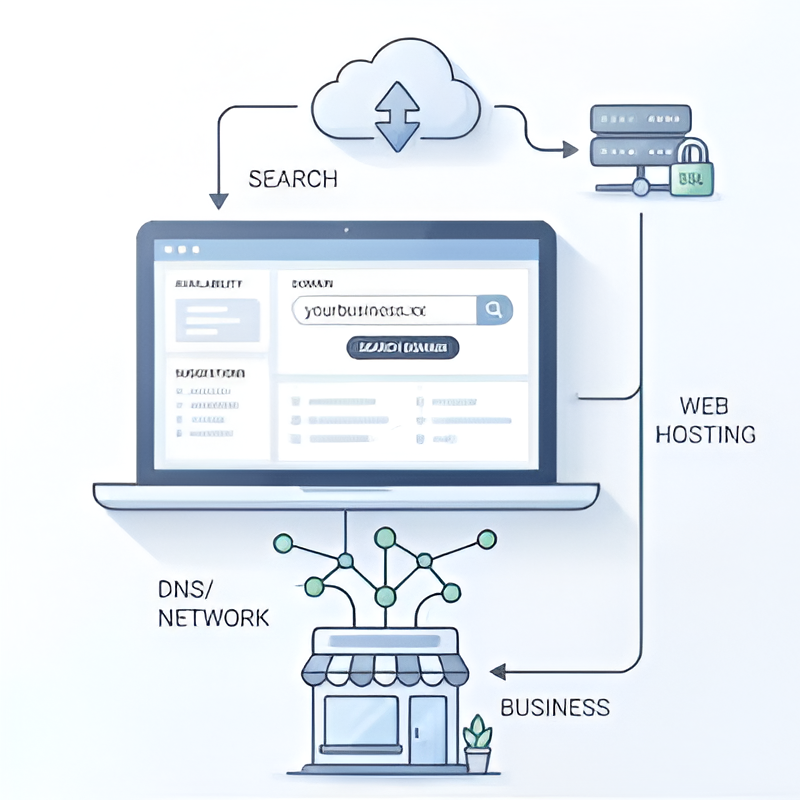
Domain hosting services combine domain registration, web server storage, and DNS management under one account so a business doesn't manage three separate vendors for a single website. The domain points to a nameserver, the nameserver resolves to the hosting server's IP address, and the server delivers the actual site files to a visitor's browser. Providers selling domain hosting for business typically run this on a dedicated hosting infrastructure tier rather than the entry-level shared pools built for personal blogs, meaning allocated CPU and memory don't fluctuate as sharply when other accounts on the same server spike in traffic.

A common setup mistake is registering a domain through one company and hosting through another, then forgetting which panel controls the nameservers when something breaks. Business domain hosting removes that ambiguity because the registrar and host share one dashboard, one support queue, and one renewal calendar. For an IT manager juggling a dozen other systems, that consolidation matters more than any single feature — it's one fewer place a renewal notice can get lost, and one fewer login shared across a growing team after someone leaves the company.

Where bundled hosting saves setup time

Setting up a business website from scratch usually means buying a domain, pointing nameservers, provisioning a mail server, installing a certificate, and configuring backups — five separate tasks that each carry their own chance of misconfiguration. Domain hosting services for business collapse most of this into a guided setup, since the registrar already controls the DNS zone the hosting account needs. This shows up most clearly during a website relaunch, when a team is under deadline pressure and doesn't want to lose days to propagation delays caused by nameserver changes across two unrelated providers.

The time saved compounds once a business runs more than one domain, which is common after a company launches a regional microsite or a product-specific landing page. A single dashboard means one invoice, one renewal date to track per domain, and one place to check before a certificate expires. This isn't a dramatic technical advantage on its own, but for a small IT team without a dedicated systems administrator, cutting the number of places something can silently fail is usually worth more than a marginally faster server.

Domain Hosting for Cape Verdean Businesses

Cape Verdean businesses hosting a domain locally or regionally face a decision most other markets don't: whether to register under .cv at all, given how that ccTLD is now marketed, and how far the hosting data center sits from the archipelago's submarine cable landing points.

Why .cv doesn't work as a local trust signal the way other ccTLDs do - Cape Verde

Why .cv doesn't work as a local trust signal the way other ccTLDs do

The .cv ccTLD is administered by the Agência Reguladora Multissectorial da Economia (ARME), which took over its management in 2009 and awarded a five-year operating contract to OlaCV in 2024. Unlike a restricted ccTLD that requires proof of local business registration, .cv has always been open to registrants worldwide with no Cape Verdean presence required, and the 2024 relaunch leaned into that openness by marketing .cv globally as short for 'curriculum vitae' rather than as a country signal. A Cape Verdean business registering under .cv today is competing in a global namespace dominated by personal résumé sites and portfolio pages, not a namespace reserved for verified local companies.

This is the opposite pattern from ccTLDs that gate registration behind local documentation, and it means a .cv address alone doesn't communicate 'Cape Verdean business' to a visitor the way it might in a market with a restricted registry. A .com domain, or a .cv address paired with clearly Cape Verde-specific branding and content, generally does more of the trust-building work than the extension itself. Businesses targeting government tenders or institutional buyers who expect a locally administered address are the exception where a .cv registration still carries direct weight.


Data center distance and connectivity for Cape Verdean visitors

Redundant data center architecture matters more once a business's hosting sits outside Cape Verde, which is the norm rather than the exception since the islands connect to the wider internet through a limited number of submarine cable landing points reaching Praia, and affordable hosting infrastructure is rarely run domestically. A well-connected data center in Europe, given the technical ties between the .cv registry and Portugal's DNS.PT association through the Lusophone LusNIC group, often gives more consistent routing for Cape Verdean visitors than a data center in a region with no established network relationship to the islands.

Renewal reviews for Cape Verdean businesses commonly turn up a previous provider running a single-region setup with no failover path, meaning one upstream outage on a single submarine cable segment or a single data center incident took the entire site offline for hours rather than the seconds a redundant setup would absorb. Asking a provider directly which region hosts the account and whether a failover path exists during a regional outage is a more useful diagnostic than relying on general uptime marketing.

SSL and Security Inside a Hosting Plan

Website security inside a hosting plan usually means more than a padlock icon in the browser bar. Domain hosting with SSL should cover certificate provisioning, renewal automation, and a hardened server environment — three things that fail independently and each cause a different kind of outage.

What SSL actually protects on a business site

An SSL certificate encrypts data traveling between a visitor's browser and the hosting server, protecting login credentials, payment details, and contact form submissions from interception on the network in between. Without it, browsers flag the site as 'Not Secure,' which erodes trust before a visitor reads a single word of content. Domain hosting with SSL folded into the plan means the certificate installs against the domain automatically rather than requiring a separate purchase, a separate validation step, and a separate renewal reminder that's easy to miss on a manually managed setup.

Per-domain SSL provisioning differs from the shared wildcard certificates some budget hosts issue across every account on a server. A dedicated certificate tied to one business domain validates faster, doesn't share a trust chain with unrelated sites, and supports stricter validation levels if a business later needs extended validation for a payment integration. The extra setup step at signup is worth the trade-off once a site starts processing customer payment information directly rather than redirecting to a third-party checkout page.

Server-side hardening beyond the certificate

A certificate alone doesn't stop a compromised plugin, a brute-force login attempt, or a malicious file upload — server-side hardening handles that layer. This typically includes a web application firewall filtering known attack patterns before they reach the site's code, malware scanning on a schedule, and file permission rules that stop an uploaded file from executing as a script. None of this is visible to a visitor, but it's the difference between a site that survives an automated bot scan and one that gets quietly defaced overnight.

Businesses handling customer payment data or personal records should confirm what access logging the host retains, since an incident review is far harder without records showing who touched a file and when. Security here is less about any single feature and more about how many independent layers exist before an attacker reaches anything that matters — a question worth asking directly rather than assuming from a plan's marketing copy.

Business Email Hosting Alongside Your Domain

Business email hosting for Cape Verde often gets treated as an afterthought to domain hosting, but a professional @yourcompany.cv or .com address does more for credibility with local and diaspora clients than most website features combined, and it fails in different ways than the website does.

Why a branded inbox changes how clients respond - Cape Verde

Why a branded inbox changes how clients respond

Domain hosting with business email means every staff member sends from an address matching the company domain rather than a free consumer inbox, which matters most in industries like tourism, finance, or import-export where clients screen unfamiliar senders before opening anything. Layered anti-spam and anti-virus filtering sits ahead of the inbox itself, scanning attachments and flagging spoofed sender addresses before a message ever reaches an employee, which matters more for a finance or operations team that regularly receives invoices and shipping documents from contacts abroad.

The filtering layer also protects outbound reputation — a compromised mailbox sending spam can get an entire domain blacklisted by major providers, which then blocks legitimate mail to every client at once. A hosting plan with layered filtering catches unusual sending patterns early, before a domain's reputation takes a hit that can take weeks to repair once major mail providers flag it.

Mailbox limits, storage, and mobile access

Mailbox storage allocation and account limits vary more between hosting tiers than buyers expect, and running out mid-quarter is a common support ticket. A growing team should check whether mailbox counts scale per additional cost or require an entirely new plan tier, since some providers gate email accounts behind their higher-priced packages rather than pricing them separately. Mobile access also behaves differently across providers — a webmail-only setup works fine at a desk but frustrates a sales team checking messages between client visits across the islands.

Native mobile client behavior differs from browser-based webmail in ways that aren't obvious until an employee needs calendar syncing, shared contacts, or offline drafting on a phone with intermittent connectivity between islands or on inter-island ferries and flights. A plan that supports native IMAP and calendar sync out of the box saves a support call later, whereas webmail-only plans often require a manual workaround that most non-technical staff won't attempt on their own.

Cloud and VPS Hosting Options for Growing Sites

Cloud hosting and VPS hosting solve the same underlying problem — a shared plan running out of headroom — but they solve it differently, and picking the wrong one usually shows up months later as an unexpected performance ceiling.

When shared hosting stops being enough

Storage pooling across a shared hosting server works fine until one account's traffic spikes and starts competing with every other account on the same machine for CPU cycles and memory. A business site running a product catalog, a booking form, or a customer portal typically outgrows this pooled arrangement faster than a static brochure site, since dynamic pages generate a database query on every visit rather than serving a cached file. The warning signs are consistent: slow page loads during a tourism-season marketing push, timeouts during a traffic spike, or a host's automated warning about resource usage.

VPS hosting solves this by carving out a fixed slice of dedicated CPU, memory, and storage that isn't shared with other accounts, so a traffic spike on someone else's site never touches a business's own performance. This costs more than shared hosting, but for a company running e-commerce, a booking portal, or anything database-heavy, the predictability is usually worth the difference once the alternative is an outage during the exact week bookings or sales matter most.

Cloud hosting for unpredictable traffic patterns

Cloud hosting allocates resources elastically rather than in a fixed VPS-style slice, scaling capacity up automatically during a traffic surge and back down once it passes. This suits businesses with genuinely unpredictable demand — a seasonal tourism operator, an event registration site, or a company running a time-limited promotion tied to a festival calendar — where paying for peak capacity year-round would waste money most months. The trade-off is billing complexity, since usage-based pricing means a viral moment or a bot-driven traffic spike can produce a larger invoice than expected without spending limits configured in advance.

A business evaluating cloud hosting should ask specifically how billing caps or alerts work before signing up, not after the first unexpectedly large invoice arrives. VPS hosting remains the more predictable choice for a company whose traffic is steady and growing gradually rather than spiking sharply, since a fixed monthly cost is easier to budget against than a usage-based bill that fluctuates with demand nobody controls directly.

Expert Hosting Guidance

Move Your Domain and Hosting to One Reliable Account

Splitting domains, hosting, and email across separate providers gets harder to manage as a business grows past its first website. Niya Digital, as an Authorized Partner for domain and hosting services, can consolidate an existing setup into one account with clear ownership and renewal tracking.

Why speak with Niya Digital?

Get a hosting plan based on real requirements.

Review your current hosting and resource usage

Recommend a hosting tier matched to actual demand

Get migration support when a change is needed

Trusted Reseller & Authorized Partner

Enterprise Domain Hosting Requirements

Enterprise domain hosting introduces requirements that a small business plan simply doesn't need to meet: multiple administrator roles, audit-ready access controls, and support response times written into an agreement rather than left to a general help desk queue.

Access control and account security at scale - Cape Verde

Access control and account security at scale

A business with a handful of employees can get by with one shared login, but an enterprise account managing dozens of domains across multiple departments needs role-based access so a marketing team member can update a landing page without also holding the ability to change nameservers or delete a mailbox. Two-factor authentication enforcement on the control panel closes the most common way these accounts get compromised — a reused or leaked password used against an exposed login page — by requiring a second verification step no phishing email can capture on its own.

Enforcing this at the account level rather than leaving it optional per user matters once a company has former employees, contractors, or agency partners who may still remember old credentials. An enterprise-grade hosting account should support audit logs showing exactly which login made a DNS change and when, which becomes essential during a security review or after a configuration error nobody can otherwise explain.

Uptime commitments and support tiers that scale

Secure domain hosting at enterprise scale usually comes paired with a defined support tier rather than a general ticket queue, since a multi-department company can't afford a multi-hour wait during a checkout outage or a DNS misconfiguration blocking email delivery company-wide. Priority support tiers typically guarantee a faster first-response window and route the ticket to someone authorized to make server-level changes immediately, rather than a first-line agent who escalates internally before anything happens.

This tier of service costs more than a standard business plan, and that cost is usually justified only once downtime has a measurable financial impact — a lost booking day for a tourism operator, a missed compliance deadline, or a reputational hit from an outage during a public campaign. A smaller business without that exposure rarely needs to pay for this tier, but it becomes a reasonable line item once the company's website or email is genuinely core to daily operations rather than a supporting channel.

Hosting Plans and Pricing Patterns in Cape Verde

Domain hosting pricing for Cape Verdean businesses typically scales with storage, mailbox count, and support tier rather than any single feature, and buyers researching options should expect a range in CVE-equivalent terms rather than a fixed figure, since exact plan inclusions vary by provider and renewal term.

What drives the price difference between tiers

Hosting plans priced for Cape Verdean businesses generally fall into a few bands: entry-level shared hosting for a brochure site typically runs a modest monthly range in CVE-equivalent pricing, business shared or entry VPS plans sit meaningfully higher once dedicated resources and more mailboxes enter the picture, and enterprise or dedicated tiers scale well beyond that depending on storage, support commitments, and the number of domains under one account. Exact figures vary enough between providers that a specific number quoted without context is rarely useful — what matters more is comparing what's actually included at each price point rather than the headline monthly cost alone.

Renewal pricing is worth checking separately from first-year pricing, since many hosting providers discount the initial term and renew at a higher rate that only shows up on the second invoice. A buyer should ask for the renewal rate up front rather than assuming it matches the promotional price used to win the account initially, since the gap between the two is where most billing surprises come from.

Renewal timing and budgeting across the year

Domain and hosting renewals for Cape Verdean businesses often land around the same mid-year window many companies use for annual budget reviews, which makes July and the months around it a practical time to audit which domains and hosting plans are actually still in active use before another renewal cycle locks in a full year of cost. A business running several domains for old campaigns or discontinued product lines can usually consolidate or drop a few during this review rather than renewing everything by default.

Invoicing format is another detail worth checking before committing to a provider. A host that issues VAT-compliant invoicing by default saves an accounts team from reconciling a foreign invoice format against local tax reporting requirements later, which is a small detail that matters more than it sounds once a company's finance team is preparing quarterly filings.

Migrating a Website Without Downtime

Website migration between hosting providers fails most often not because of the file transfer itself, but because of DNS hosting changes made in the wrong order, leaving a domain pointing at nothing for the minutes or hours propagation takes to complete.

The DNS sequencing that prevents downtime

A safe migration keeps the old hosting account live while the new one is fully configured and tested, then switches the DNS records only after confirming the new server serves the site correctly using a temporary hosts-file override or a staging subdomain. Migration concierge support from a hosting provider typically manages this sequencing directly, testing email deliverability, database connections, and SSL provisioning on the new server before touching a single DNS record on the live domain, which is the step most self-managed migrations skip under time pressure.

Skipping this staged approach is the single most common cause of a business losing email for several hours mid-migration, since mail servers cache DNS records for longer than a browser does and a mismatched MX record can silently bounce incoming messages for anyone still sending to the old configuration. A short overlap window where both old and new servers stay reachable removes almost all of this risk for a modest amount of extra planning time.

What to check before calling a migration complete

A migration isn't finished once the site loads on the new server — forms need testing end to end, email needs to send and receive correctly from multiple external addresses, and any scheduled backup jobs need reconfiguring since backup schedules rarely transfer automatically between providers. SSL certificate validity on the new server deserves a direct check too, since a certificate issued against the old server's configuration doesn't always reapply cleanly without a manual reissue step.

A final DNS propagation check across multiple geographic regions confirms the change has fully taken effect rather than assuming it based on one local browser test, since propagation timing varies by the visitor's own DNS resolver and can lag for stragglers even after the majority of traffic sees the new server. Waiting 24 to 48 hours before decommissioning the old hosting account entirely is standard practice for exactly this reason.

Choosing a Domain Hosting Provider

The best domain hosting for business isn't necessarily the cheapest listed price, since a domain hosting provider serving Cape Verde competing purely on entry cost usually recovers margin through renewal pricing, mailbox add-on fees, or a slower support queue that only becomes visible after signing up.

What separates a reseller-managed account from a generic one

Reseller-managed provisioning speed is one of the more overlooked differences between providers — an authorized reseller with direct backend access to the underlying infrastructure can typically activate a plan, change a nameserver, or add a mailbox within minutes, while a smaller reseller working through several layers of ticketing may take a business day to complete the same request. This matters most during time-sensitive situations: a domain expiring unexpectedly, an email account needed for a new hire starting the next morning, or an SSL renewal that lapsed without warning.

A provider positioned as a Trusted Reseller or Certified Sales Partner, rather than presenting itself as the underlying registrar or infrastructure owner, should still be transparent about who actually operates the servers and data centers behind the plan being sold. That transparency matters less for the marketing copy and more for knowing who to escalate to if a data center-level issue occurs that a reseller alone can't resolve directly.

Questions worth asking before signing a contract

A short list of direct questions filters out most weak providers quickly: what is the renewal price after the first term, which data center region hosts the account, what backup frequency is included by default, and what the actual first-response time is for a priority support ticket rather than a general one. A provider that answers these clearly and specifically, without redirecting to vague marketing language, is generally more trustworthy than one relying on broad claims about being the best or most reliable option available.

It's also worth asking directly how a migration from the current provider would be handled, since a provider unwilling to commit to a staged, low-downtime migration process is signaling something about how much operational support to expect after the contract is signed. The comparison below outlines how plan tiers typically differ across storage, email, and support commitments.

Domain Hosting Plan Comparison

A general comparison of how hosting tiers typically differ in storage, email, SSL, backups, and support commitments.

Hosting TierStorage AllocationEmail Accounts IncludedSSL ProvisioningBackup FrequencySupport PriorityTypical Business Size
Shared Hosting10–20 GB pooled5–10 mailboxesShared wildcard SSLWeeklyStandard queue1–5 employees
Business Shared30–50 GB pooled15–25 mailboxesPer-domain SSLDailyStandard queue5–15 employees
VPS Entry60 GB dedicated30 mailboxesPer-domain SSLDailyPriority queue15–30 employees
VPS Business120 GB dedicated50 mailboxesPer-domain SSL + wildcard subdomainDaily plus on-demandPriority queue30–60 employees
Cloud ScalableElastic, usage-based75 mailboxesPer-domain SSLContinuous snapshotPriority queue60–150 employees
Enterprise Dedicated250 GB+ dedicatedUnlimited mailboxesPer-domain SSL with EV optionContinuous snapshotDedicated account manager150+ employees
Agency/Reseller TierCustom pooled allocationCustom per client sitePer-domain SSLDailyPriority queueAgencies managing multiple client sites
Migration Concierge Add-onNot applicableNot applicableReissued on new serverPre- and post-migration snapshotDedicated migration engineerAny tier, during a provider switch

Hosting for Cape Verdean SMEs and .cv Domains

Hosting for Cape Verdean SMEs usually needs to balance cost against reliability more tightly than an enterprise budget allows, and deciding whether a .cv domain fits the brand at all adds a step most first-time business owners haven't weighed carefully before registering.

Budgeting realistically for a first business website - Cape Verde

Budgeting realistically for a first business website

A Cape Verdean SME launching its first website typically starts on business shared hosting rather than VPS, since the traffic volume in the first year rarely justifies dedicated resources, and moving up a tier later is usually a straightforward upgrade rather than a full migration. What matters more at this stage is choosing a plan that includes business email from day one, since a company using a free consumer email address on business cards and invoices signals something unintended to new clients evaluating whether to trust a still-unfamiliar company.

Domain hosting for Cape Verdean startups should also weigh whether .cv actually serves the brand, given how thoroughly the extension has been repurposed globally for résumé and portfolio sites since the 2024 relaunch under OlaCV. A tourism operator, retailer, or professional services firm chasing local recognition is often better served registering .com as the primary address, with a .cv registration held defensively rather than used as the public-facing domain, unless the business specifically wants to lean into the 'CV' wordplay for a personal-brand or recruiting-adjacent service.

Growing past the first hosting plan without starting over

The mobile experience of managing hosting matters more for a small Cape Verdean business than it might for a larger company with a dedicated IT department, since the person managing the domain, email, and website is often the same person handling sales calls and supplier relationships from a phone between meetings or while traveling between islands. A hosting provider whose control panel and support channel work reasonably well on mobile, rather than requiring a desktop browser for every routine task, removes friction for exactly the kind of owner-operator who doesn't have a spare hour at a desk each week.

As a Cape Verdean SME grows past its first year, the practical signal that it's outgrown its starting plan is usually a slowdown during a seasonal promotion or a mailbox that fills up faster than expected — both solvable with a plan upgrade rather than a full provider switch, provided the original hosting account was set up with a reasonable upgrade path rather than a rigid entry-level package.

Get Your Domain and Hosting Set Up the Right Way

Choosing between .cv and .com, sizing a hosting plan correctly, and setting up business email shouldn't require guesswork. Niya Digital's team, as an Authorized Partner, can walk through the right combination for a Cape Verdean business and handle setup, migration, or renewal directly.

Ready to get started?

Register your domain, launch your website, and build a secure digital presence with trusted hosting and expert support.

20+

Years

50,000+

Domains

24/7

Support

Frequently Asked Questions

Pricing varies by storage, mailbox count, and support tier rather than a single fixed figure, so treat any quoted number as an approximate range rather than a fixed price. Entry-level shared hosting plans sit at the lower end in CVE-equivalent terms, while business shared or entry VPS plans cost meaningfully more once dedicated resources and additional mailboxes are included. The bigger factor most buyers miss is the renewal rate rather than the first-year price, since many providers discount the initial signup term and increase pricing at renewal. It's worth requesting the second-year rate directly during the sales conversation rather than assuming it matches the promotional rate quoted at signup, since that gap is where most unexpected cost increases originate.

This depends on what the domain needs to signal. Since the 2024 relaunch of the .cv registry under OlaCV, the extension is marketed worldwide as shorthand for 'curriculum vitae' rather than as a Cape Verde signal, and registration has never required local presence, so a .cv address doesn't automatically read as a verified local business the way some other country domains do. Most Cape Verdean businesses targeting local or regional customers get more consistent brand recognition from .com, registering .cv defensively alongside it rather than as the primary public address, unless the business specifically wants the résumé-related wordplay a .cv extension carries internationally.

Yes, provided the migration keeps the old hosting account active while the new one is configured and tested, switching DNS only after the new server is confirmed working. A staged migration tests the site, forms, database connections, and email deliverability on the new server before any DNS record changes, which avoids the downtime that happens when providers cut over before testing is complete. Email is usually the riskiest part of a migration, since mail servers cache DNS records longer than browsers do, so a short overlap window where both the old and new mail servers stay reachable prevents incoming messages from silently bouncing during the transition period.

Shared hosting pools server resources across many accounts on one machine, which works fine for a static or low-traffic site but means a traffic spike on someone else's account can slow down your own site during peak periods. VPS hosting allocates a fixed slice of dedicated CPU, memory, and storage that isn't shared with other customers, giving more predictable performance for a site running a database-backed feature like a booking system or product catalog. The practical trigger for upgrading is usually a slowdown during a marketing push or a resource-usage warning from the current host, rather than a specific traffic number to plan around in advance.

This depends entirely on the plan tier, so it's worth confirming directly rather than assuming email is bundled. Many business-focused hosting plans include a set number of mailboxes tied to the domain, while lower-cost or personal-tier plans may charge separately for email hosting or cap mailbox counts low enough that a growing team outgrows them quickly. Beyond mailbox count, check whether the plan includes spam and virus filtering as standard, since an unfiltered inbox on a business domain is a common way a company's outbound sending reputation gets damaged by a single compromised account.

A .com domain registration typically completes within minutes, and .cv registrations move just as quickly since ARME's current registry operator supports a fully automated system with no local documentation requirement. Hosting account activation is usually near-instant with a reseller-managed provisioning setup, and SSL certificates issue automatically against the domain within minutes to a few hours depending on validation type. Business email accounts can typically be created immediately once the hosting account is active. The overall timeline for a functioning website with email, assuming content is ready to upload, is often same-day for most Cape Verdean businesses.

Most hosts run a grace period after the renewal date before suspending a hosting account, though the length varies by provider and isn't something to rely on as a buffer. During suspension, the website typically goes offline and email delivery stops, which is more disruptive for a business than for a personal site since missed emails during that window often can't be recovered afterward. Domains carry their own separate expiration and grace period from hosting, and a lapsed domain risks being released for public registration by someone else if it passes both the grace period and any subsequent redemption window without renewal.

A hosting plan with server-side security layers — malware scanning, a web application firewall, and access logging — gives a provider's support team a starting point for identifying how a compromise happened and what files were affected. Plans without this logging make an incident review far slower, since there's no record of which login or script made unauthorized changes. Priority support tiers typically respond faster to a security incident than a standard queue, which matters when every hour a compromised site stays live risks further damage to search rankings or customer trust from browser security warnings.

Most business hosting plans are designed for a non-technical owner to manage day-to-day tasks like adding a mailbox or checking a renewal date through a control panel, without needing a dedicated systems administrator. Where a business benefits from outside help is at setup, migration, and security configuration stages, where a mistake in DNS sequencing or certificate installation can cause downtime that's harder to diagnose without technical background. A migration concierge service or a reseller's setup support typically covers exactly this gap, handling the technical configuration once while leaving routine management to the business owner afterward.

Ask directly which data center region hosts the account, whether a failover path exists during a regional or submarine-cable outage, what the actual first-response time is for a support ticket, and what the renewal price will be next term. A reliable provider answers these specifically rather than redirecting to general uptime claims. A practical warning sign is a provider that can't explain its own infrastructure setup in plain terms, since that usually means the account is resold through several unclear layers rather than managed by a provider with direct backend access and accountability for the underlying servers.

Case Studies

Consumer ServicesInternationalized Domain Names (IDN) & Localization

A consumer services business expanding into new markets — including a push into Nigeria's local-language search and communications landscape — wanted its domain strategy to genuinely support local-language audiences, rather than relying on...

Read More about Internationalized Domain Names for Local-Market Reach

Key Takeaways

Domain hosting bundles domain registration, server storage, and DNS management under one account, reducing the number of vendors and logins a business has to track.

For Cape Verdean businesses, .cv no longer reads as a strong local-trust signal since its 2024 global relaunch as a 'curriculum vitae' brand — .com often does more work for local credibility.

SSL and business email are not optional add-ons for a credible business site — check whether they're included per-domain rather than shared or capped.

VPS or cloud hosting becomes worth the added cost once a shared plan starts showing slowdowns during traffic spikes or resource-usage warnings.

Always ask for the renewal price, data center region, and backup frequency before signing, since these details matter more than the first-year headline price.

A staged migration that keeps the old host live until the new one is fully tested is the single biggest factor in avoiding downtime during a provider switch.

Customer Success Stories

From startups and e-commerce businesses to financial platforms and global enterprises, organizations across different industries rely on dependable domain registration, hosting, DNS management, and security services to support business growth and protect their online presence.

"We were three weeks from launch and treating domain registration as an afterthought — grab the name, move on. The team walked us through variant registrations and locking before we'd even considered them. Two years later, we've never had a brand-protection scramble, which is exactly what we were told to expect but didn't fully appreciate until we saw the alternative play out with a competitor."

Marcus Whitfield

Co-Founder

Technology Startup

United StatesDomain Registration

"Our domains were expiring on five different schedules across three different staff inboxes before we brought everything under one renewal system. It's not glamorous work, but knowing our storefront and support portal can't accidentally lapse has removed a risk I used to lose sleep over during peak season."

Sarah Bouchard

Director of IT Operations

Online Retail Company

CanadaDomain Renewal

"We'd grown into a mess of registrar logins across departments and needed to consolidate without touching our live website or email. The transfer was scoped tightly, monitored domain by domain, and we didn't experience a single hour of disruption. That discipline around scope is what I'd recommend to any firm considering the same move."

James Okafor-Reid

Head of Technology

Professional Services Firm

United KingdomDomain Transfer

"Our DNS zone had become tribal knowledge spread across half a dozen engineers, and it showed every time someone made a change without knowing what it touched. Having every record documented and mapped to the service it supports has taken a genuine source of operational risk off the table."

Lena Vogt

VP of Engineering

B2B Software Company

GermanyDNS Management

"For a platform processing customer transactions, we needed to show auditors exactly who could change production DNS and why. The access controls and change logging we put in place turned what used to be an uncomfortable audit conversation into a straightforward one."

Rachel Tan

Chief Information Security Officer

Financial Technology Platform

SingaporeDNS Management (Compliance)

"We'd been treating our domain and our web host as the same thing for years, which made every infrastructure decision feel bigger than it needed to be. Separating DNS hosting from web hosting meant our last platform migration was a contained, unremarkable change instead of the ordeal our earlier moves had been."

Daniel Foster

Head of Infrastructure

Digital Commerce Business

AustraliaDomain Hosting

"Within weeks of registering my domain, I was fielding calls and emails clearly sourced from public WHOIS data. Enabling privacy protection while keeping our actual registrant details accurate solved the problem properly, rather than the workaround of submitting false information that I'd seen other small business owners resort to."

Priya Raghunathan

Founder

Independent Online Business

IndiaWHOIS Privacy Protection

"We wanted a specific domain that was approaching expiration but didn't want an engineer manually checking its status every few days. Having the lifecycle monitored systematically, with our budget and criteria agreed upfront, meant we were ready to act the moment it became available instead of reacting under pressure."

Kenji Matsuda

Product Lead

Consumer Technology Company

JapanDomain Backorder / Expired-Domain Acquisition

"Auction environments are designed to make you overpay for scarcity. Having a defined evaluation checklist — brand fit, trademark screening, total cost, and a hard bid ceiling — kept our decision grounded in what the domain was actually worth to us, not what the bidding pressure made it feel worth in the moment."

Fatima Al-Suwaidi

Chief Marketing Officer

Online Retail Company

United Arab EmiratesDomain Auction Advisory

"We were launching several properties at once, and I was far more worried about what would happen a year later than about the registrations themselves. Every domain came with a named owner and a documented purpose from day one, which meant we never ended up with the orphaned domains that plague most bulk launches."

Rafael Nogueira

Director of Digital Marketing

Digital Marketing Organization

BrazilBulk Domain Registration

"Expanding into local-language search meant our domain strategy needed to be more than a translated version of our global brand. Compatibility testing across email and DNS before we committed to our localized domains saved us from support issues we later learned other companies ran into after rolling out IDNs without that step."

Chiamaka Eze

Regional Growth Manager

Consumer Services Company

NigeriaInternationalized Domain Names & Localization

"Once we recognized that a domain compromise for us wouldn't just be a website outage but an authentication incident, we treated it accordingly — locked, access-restricted, DNSSEC-enabled, and reviewed alongside our other security controls. It's now part of our formal security architecture review, not a separate IT checklist item."

Willem de Groot

Chief Technology Officer

Financial Technology Platform

NetherlandsDomain Security

"Our biggest exposure was never fraud — it was the idea of a hijacked domain publishing something under our name before we could even respond. The DNS monitoring and dedicated incident-response path we now have means we'd catch that in minutes, not hours, which for a publisher is the entire difference."

Naledi Dlamini

Head of Digital

Media & Publishing Organization

South AfricaDomain Security (Media & Brand Protection)

"Every new market we entered brought its own small wave of domain decisions, and eventually nobody could tell you what we actually owned. Building a single inventory with clear ownership and consistent controls turned an invisible governance gap into something we can now manage deliberately as we keep expanding."

Minh Tran

Regional Operations Director

Digital Commerce Business

VietnamDomain Portfolio Management

"We didn't realize how much client-facing email was quietly landing in spam until we looked closely at our SPF and DKIM configuration across our domains. Rebuilding our authentication properly, rather than patching it domain by domain as complaints came in, made a measurable difference in what our clients actually saw land in their inbox."

Isabela Cruz

Director of Client Services

B2B Professional Services Firm

PhilippinesEmail Hosting & Deliverability

Glossary

Quickly understand the technical terms used throughout this guide. Search any keyword below to find its definition.

DNS (Domain Name System)

The system that translates a domain name into the numeric address of the server hosting a website, acting as the internet's directory lookup.

Nameserver

A server that holds a domain's DNS records and tells browsers where to find the website and mail server associated with that domain.

SSL/TLS Certificate

A digital certificate that encrypts data between a visitor's browser and a hosting server, enabling the secure HTTPS connection shown by a padlock icon.

VPS (Virtual Private Server)

A hosting environment that allocates a fixed, dedicated slice of a physical server's resources to one account, rather than sharing them across many customers.

cPanel

A widely used web hosting control panel that lets a business manage files, email accounts, databases, and domain settings through a graphical interface.

CDN (Content Delivery Network)

A network of distributed servers that caches and delivers website content from a location closer to the visitor, reducing load times.

WHOIS Privacy

A service that masks a domain owner's personal contact details in the public WHOIS lookup database, replacing them with proxy information.

SPF Record

A DNS record that lists which mail servers are authorized to send email on behalf of a domain, helping prevent spoofed messages from being delivered.

Authorized Partner / Reseller

A company certified to sell and provision hosting or domain services on behalf of an underlying infrastructure provider, without owning the infrastructure itself.

Authoritative Resources

Discover reliable information about domain names, DNS, and country-code top-level domains (ccTLDs) from trusted organizations, official registries, and global authorities.

IANA - Root Zone Database

https://www.iana.org/domains/root/db

ICANN - Domain Name Registration Information

https://www.icann.org

.cv ccTLD - Wikipedia

https://en.wikipedia.org/wiki/.cv

About the Author

Niya Digital Team

The Niya Digital Team is a team of domain and web infrastructure specialists focused on helping individuals and businesses manage their online presence with confidence. Our expertise covers domain registration, transfers, DNS management, domain security, and portfolio management. We research industry updates, follow registrar policies and best practices, and publish clear, practical guides that are regularly reviewed for accuracy and updated to reflect changes in the domain industry. Learn more about our editorial team and standards at Niya Digital.

;
Facebook
X
LinkedIn
WhatsApp
Telegram
Pinterest