


























































































































































































Niya Digital

Domain Hosting Services for Business in Latvia

A Latvian business buying a domain and server space separately ends up managing two renewal calendars, two support lines, and two places where a DNS record can drift out of sync. Domain hosting merges the two into one account, with EU data placement as the deciding factor for many buyers here.

Domain Registrations @ $14.99 | Domain Renewals @ $15.99

Domain Hosting for Business in Latvia

*1dollardomainhosting is owned & operated by Niya Digital.

What Domain Hosting Services Actually Bundle Together

Domain hosting services pair a registered domain name with the server resources, control panel, DNS management, and SSL certificate that keep a website and its email running. Buying them together removes the coordination gap that opens whenever a domain sits with one vendor and the server sits with another.

The Core Components in a Bundled Plan

A bundled domain hosting for business plan generally includes domain registration, server storage on a shared, VPS, or cloud tier, a control panel for files and email, DNS management, and at least one SSL certificate issued for the domain. One login and one billing relationship cover all of it, rather than a separate registrar invoice arriving on a different date than the hosting renewal.

Low-cost domain hosting services draw CPU, memory, and disk I/O from a shared pool that many accounts pull from at once, which is fine for a low-traffic informational site but starts to show under a marketing campaign spike or a busier e-commerce build. A dedicated hosting infrastructure tier reserves a fixed slice of those resources per account instead of leaving performance dependent on what neighboring accounts happen to be doing that day. A business comparing plans should ask directly whether resource limits are guaranteed or shared, since that single detail affects site speed more than almost any other spec on a pricing page.

Who Actually Needs a Bundled Setup

Once a website starts generating leads, taking bookings, or processing orders rather than sitting as a static company profile, the case for a bundled account gets stronger, because a DNS change made for one purpose, adding a new subdomain or adjusting mail routing, almost always touches both the domain and the hosting side at the same time. A two-vendor split still works for a very simple single-page site, but it means tracking two support relationships and two invoices for something that rarely needs to be managed separately in practice.

IT and outsourcing firms, logistics and transit-trade companies, and manufacturers exporting from Latvia into the wider EU market are among the businesses most likely to outgrow a basic shared account within their first eighteen months, since initial traffic and storage estimates tend to run low. A bundled plan that allows a move from shared resources to VPS or cloud hosting without touching the domain record avoids a disruptive rebuild later, and a company running several brand domains gains a single renewal calendar instead of tracking expiry dates for each domain name hosting account separately.

Business Domain Hosting Built Around EU Data Placement

Business domain hosting in Latvia carries a compliance dimension that many markets outside the EU do not: where the server physically sits matters under GDPR, not just how fast it responds. That shapes the choice between a .lv domain, a .com domain, and where the underlying data center is located.

Choosing Between .lv and .com for a Latvian Business - Latvia

Choosing Between .lv and .com for a Latvian Business

Latvian companies trading mainly within the domestic and Baltic market often register a .lv domain because it signals local presence clearly in search results and to customers who associate the extension with a registered Latvian business, while companies expecting customers across the EU or internationally usually lead with .com and register the matching .lv defensively so it cannot be picked up separately. Neither extension changes hosting performance; the decision is about audience recognition rather than infrastructure.

Unlike some country-code domains that require proof of a registered local business before the registration completes, .lv registration through an authorized reseller is comparatively straightforward and does not require a Latvian trade license, though registrant contact details still need to be accurate and kept current under the registry's terms. A business holding both extensions should point them at the same hosting account and set a redirect from the secondary domain to the primary one, avoiding a duplicate-content problem search engines penalize.

Why Data Location Inside the EU Matters Here

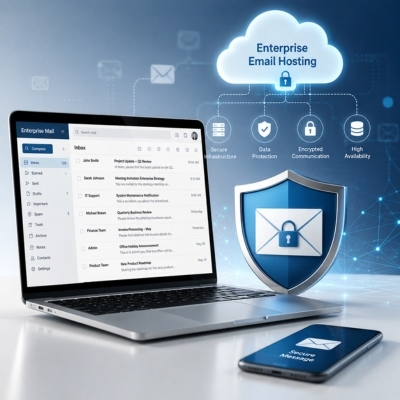
Redundant data center architecture across more than one EU-based facility does two things for a Latvian business at once: it protects against a single-location outage, and it keeps personal data processing within the European Economic Area, which simplifies GDPR compliance considerably compared with infrastructure that routes data through a facility outside the EU. A hosting plan built on a single non-EU data center forces a business to justify that data transfer under GDPR's rules on international transfers, an extra compliance step most small companies would rather avoid entirely.

A provider serving the Latvian market should be able to confirm, in writing, which country or countries host a given account's data, since that detail belongs in any data processing agreement a business signs with its own customers. Renewal reviews commonly turn up a hosting contract signed years earlier with no data location clause at all, which was rarely an issue before GDPR enforcement tightened but now leaves the business unable to answer a customer's data-residency question with certainty.

SSL Coverage Inside a Domain Hosting Plan

An SSL certificate encrypts the connection between a visitor's browser and the server, and a site missing one now shows a visible browser warning before a visitor reads any content. Domain hosting with SSL included removes a step businesses otherwise forget until that warning costs them a sale.

What SSL Actually Protects and Why Its Absence Gets Flagged

SSL, technically superseded by TLS (Transport Layer Security) though the older name remains standard usage, encrypts data moving between a visitor and a website, protecting login credentials, payment details, and form submissions from interception on the way. Browsers now mark any unencrypted connection as not secure, a warning that erodes trust in seconds and measurably reduces conversion on checkout and contact pages.

Search engines also treat an active SSL certificate as a baseline ranking factor, so a domain hosting for business account without one carries a quiet search visibility cost layered on top of the trust problem. Coverage needs to extend across every subdomain in active use, including both the www and non-www versions of the same domain, because a mismatch between the two produces the identical warning as having no certificate at all. A business handling checkout on its own domain, rather than through a third-party payment page, should confirm SSL coverage extends specifically to that checkout subdomain.

Provisioning and Renewal Without Manual Tracking

Per-domain SSL provisioning issues and renews a certificate automatically for every domain on the account rather than depending on someone to request and install a replacement before the existing one expires. A lapsed certificate produces the same warning message as never having installed one in the first place, and manual SSL tracking is one of the more common gaps found during a security review of a hosting account that has changed hands or gone unmanaged for a stretch.

Wildcard certificates cover a domain and an unlimited number of its subdomains under one certificate, which suits a business running separate subdomains for different departments, regions, or product lines from a single root domain, while a standard single-domain certificate is sufficient for most straightforward business websites. Either type should renew automatically roughly a month ahead of expiry as part of domain hosting services, with an email notification serving as a secondary check rather than the primary safeguard against a lapse.

Business Email Hosting Tied to the Company Domain

An email address ending in a company's own domain rather than a free consumer service reads as more credible to customers and vendors, and it keeps mailbox provisioning, spam filtering, and domain DNS records inside one account rather than a separate vendor relationship for email alone.

Why a Branded Address Changes How Customers Respond - Latvia

Why a Branded Address Changes How Customers Respond

[email protected] reads differently to a recipient than a generic consumer webmail address, and mail servers weigh domain reputation heavily when filtering incoming messages, so a branded domain address tends to see fewer messages routed into spam folders on the receiving end. A consistent address format across a team also makes it easier for a vendor or customer to guess or verify a contact's email correctly on the first attempt.

Provisioning a new mailbox on a business email plan usually takes minutes through the hosting control panel, letting a company set up a new hire's inbox the same day they start rather than waiting on a separate email vendor's onboarding queue. Keeping mailbox storage, spam filtering, and the domain's DNS records inside one account also means a single support ticket resolves an issue that would otherwise require coordinating between two vendors, one for the domain and one for the mailbox.

Filtering, Deliverability, and Handling Personal Data in Mail

Layered anti-spam and anti-virus filtering checks incoming mail at several points rather than relying on one spam score, combining sender reputation checks, attachment scanning, and content analysis before a message reaches an inbox, and a single-layer filter routinely lets through a convincing phishing attempt that a layered system would catch earlier. Business email accounts frequently carry personal data covered by GDPR, customer names, order details, contact information, so the mail server itself falls inside a company's broader data processing footprint, not just an operational tool sitting outside compliance scope.

SPF (Sender Policy Framework), DKIM (DomainKeys Identified Mail), and DMARC (Domain-based Message Authentication, Reporting and Conformance) records together tell receiving mail servers which sources are authorized to send mail for a domain, and a stale SPF record still authorizing a mail service the company stopped using two providers ago is one of the more common findings during a migration review, quietly weakening sender reputation without blocking mail outright. All three records deserve a fresh check whenever email or hosting providers change, rather than being carried forward unexamined from the previous setup.

Cloud and VPS Hosting for Growing Traffic

Shared hosting handles a straightforward business site until traffic, application complexity, or storage needs outgrow what a shared server can reliably support. VPS (Virtual Private Server) and cloud hosting both offer a step up, addressing slightly different growth problems.

VPS Hosting: Dedicated Resources on Shared Hardware

A VPS partitions a physical server into isolated virtual environments, each guaranteed a fixed share of CPU, memory, and storage that other accounts on the same hardware cannot draw down, unlike shared hosting where resources come from a common pool. It fits a business running a database-backed application, a custom-built platform, or traffic heavy enough to strain a shared plan's limits.

Root or administrator-level access on a VPS lets a technical team install specific software versions and adjust server configuration in ways a standard shared environment does not permit, though that flexibility shifts responsibility for security patching onto the account holder unless the plan is managed. A managed VPS, where the provider handles operating system updates and patching, suits most business buyers better than an unmanaged plan requiring a dedicated systems administrator on staff. Upgrading from shared to VPS should keep the same domain, DNS records, and email accounts intact rather than requiring a fresh setup from zero.

Cloud Hosting: Absorbing Spikes Without a Manual Upgrade

Cloud hosting draws compute and storage from a distributed pool of servers rather than a single physical machine, so a sudden traffic spike gets absorbed by shifting load across that pool instead of forcing a manual upgrade mid-crisis. Storage pooling in particular removes the ceiling imposed by one machine's physical disk size, letting storage scale as a shared cluster resource, which matters for a retailer with a large product catalog carrying high-resolution imagery or video.

A seasonal exporter running a promotional push, or any business bracing for an unpredictable spike from a marketing campaign or press coverage, gets more value from cloud hosting's elastic capacity than from a fixed VPS allocation sized for average traffic. A company with steady, predictable traffic and a tighter budget often finds VPS more cost-efficient, since it avoids paying for elasticity it rarely uses. Domain hosting worth signing up for should offer a clear path between shared, VPS, and cloud tiers inside the same account, so growth never forces a full migration.

Expert Hosting Guidance

Scale Hosting Resources Without Losing Domain History

Moving from a shared plan to VPS or cloud resources should not mean rebuilding a domain hosting account from scratch. Niya Digital, as an Authorized Partner and Certified Sales Partner, manages that upgrade path within the same account, keeping DNS, SSL, and email configuration intact through the change.

Why speak with Niya Digital?

Get a hosting plan based on real requirements.

Review your current hosting and resource usage

Recommend a hosting tier matched to actual demand

Get migration support when a change is needed

Trusted Reseller & Authorized Partner

Enterprise Domain Hosting for Multi-Site Operations

Enterprise domain hosting covers a business running several websites, subdomains, or regional brands under one account, where an outage or a security gap on one property can damage trust across the whole portfolio. Support responsiveness becomes as important as raw infrastructure at this scale.

Priority Support as a Structural Requirement, Not a Perk - Latvia

Priority Support as a Structural Requirement, Not a Perk

A hosting outage affecting several revenue-generating domains at once costs a multi-site enterprise more per hour than the same outage costs a single-site business, simply because the exposure multiplies across every property sharing the account. A standard support queue, where a ticket waits behind consumer-plan requests regardless of severity, does not match that exposure.

Priority support tiers route enterprise account tickets into a separate queue with a defined response target, often measured in a small number of hours rather than a next-business-day window, and typically pair that with a named or small-team point of contact who already understands the account's domain and hosting configuration rather than starting from scratch on every ticket. An enterprise buyer evaluating secure domain hosting should ask specifically whether priority routing applies to every domain on the account or only to a primary one, since the answer affects incident response for every subdomain the business runs.

Access Control Across Multiple Domains and Users

An enterprise account spanning several domains under different departments or brands needs role-based access control, so a content editor on one property cannot reach billing, DNS records, or an unrelated domain elsewhere on the same account. Without granular permissions, most hosting setups default to an all-or-nothing model where every logged-in user effectively holds full control, which is a larger exposure than most businesses recognize until an access review turns up a former contractor or agency still holding administrative rights months after the engagement ended.

Centralized activity logging across every domain, showing who changed a DNS record, renewed a certificate, or altered a server configuration and when, matters most during an incident review, when reconstructing exactly what changed determines how quickly the underlying cause gets resolved. Single sign-on support for the team managing the account reduces the number of separate credentials tied to sensitive infrastructure and makes revoking access for a departing employee a single action rather than a multi-system cleanup.

Domain Hosting Pricing Patterns in Latvia

Domain hosting pricing in Latvia varies with resource tier, contract length, and whether SSL, business email, and EU data placement are bundled in or billed as extras. A general sense of the range helps a business budget before requesting a specific quote.

What Drives the Range Between Tiers

Domain hosting pricing in Latvia typically starts around 15 to 35 EUR per year for basic shared hosting bundled with a domain, moving to roughly 70 to 180 EUR per year for VPS-tier plans with dedicated resources, with exact figures depending on the provider, the contract term, and which extras like SSL or business email come included versus billed separately.

Cloud and enterprise-tier pricing moves outside a fixed annual figure entirely, scaling instead with actual resource consumption, storage volume, and the number of domains or mailboxes on the account, which makes a published range less useful than a direct quote built around projected traffic and storage. Business customers with a valid EU VAT number registered in another member state may be entitled to reverse-charge VAT treatment on the invoice rather than paying local VAT directly, a detail worth raising with the provider's billing team rather than assuming from a generic price list. Domain hosting pricing should always be requested as a written quote against the specific combination of tier, extras, and invoicing requirements a business actually needs.

Renewal Pricing and VAT-Compliant Invoicing

Latvian businesses running an annual hosting contract typically align its renewal with their broader annual budgeting and VAT reporting cycle, and 2026 renewal reviews are showing more companies consolidating domain, hosting, SSL, and email renewal dates into a single annual invoice rather than letting each component lapse or renew on its own separate schedule. A consolidated renewal date also simplifies VAT-compliant invoicing, since one invoice covering the full bundle is easier to reconcile against a single accounting period than several smaller invoices arriving throughout the year.

Introductory pricing on a first-year contract is common industry-wide and should not be mistaken for the ongoing rate, since the renewal price after that first term is often noticeably higher, a detail worth raising during the initial quote conversation rather than discovering it on the first renewal invoice. A business should also confirm the invoice will show a proper VAT breakdown, including the provider's VAT registration number, since an invoice missing that detail can complicate a company's own VAT reclaim process at the end of a reporting period.

Website Migration and DNS Management

Moving a website between hosting providers, or consolidating a domain and hosting account previously split across two vendors, takes more than copying files across. DNS propagation timing and email continuity both need planning before the switch happens.

How DNS Propagation Actually Works During a Switch

DNS (Domain Name System) propagation is how updated domain records spread across the internet's distributed network of DNS servers after a change, and it typically completes within a few hours to 48 hours depending on the time-to-live (TTL) value set on the previous records. Some visitors reach the old server while others reach the new one until propagation finishes.

Lowering the TTL value on existing records to a short interval, five or ten minutes, a day or two ahead of a planned migration shortens that inconsistent window once the switch actually happens, since resolvers cache a record for the duration of its TTL before checking the source again. Email delivery deserves particular care during migration, since mail servers around the world may resolve a domain's MX records to either the old or new mail server inconsistently during propagation, and a poorly timed switch can cause inbound mail to bounce or route to a server no longer in service. Scheduling the cutover for a low-traffic period, and keeping the old hosting account active for at least 48 hours afterward, avoids most disruption businesses associate with a migration.

What a Managed Migration Actually Handles, Including a Move to EU Infrastructure

A migration concierge service handles file transfer, database migration, DNS record replication, and email account recreation on a business's behalf, rather than leaving a non-technical team to piece the process together from a provider's documentation. A growing number of migrations into Latvia are driven specifically by a business consolidating infrastructure onto EU-based servers for GDPR reasons, moving away from a legacy host outside the EEA rather than switching purely for price or performance, and that motivation changes the checklist: confirming the new provider's data center location and reviewing the data processing agreement matters as much as the technical cutover itself.

Migration reviews commonly turn up hardcoded absolute file paths or database connection strings left over from the original site build, references that break silently once the site lands on new server infrastructure with a different directory structure, and catching these before launch avoids a broken checkout page or contact form going unnoticed for days. A well-run migration also preserves URL structure exactly, or sets up correct redirects for any URL that does change, since a large number of broken links discovered during re-crawling can temporarily reduce a site's search visibility while search engines re-index the new location.

Comparing Domain Hosting Providers in Latvia

Choosing between domain hosting provider options in Latvia comes down to a handful of decision points: data center location, contract flexibility, security defaults, and how a plan scales without forcing a full migration. Comparing on headline price alone misses most of what actually affects day-to-day reliability.

Security Defaults Worth Checking Before Signing

The best domain hosting for business enforces two-factor authentication (2FA) on account logins by default, rather than leaving it as an optional setting a customer has to switch on manually, since account-level compromise causes a larger share of hosting security incidents than server-level attacks do. A provider treating 2FA as optional is signaling a lower security baseline across its other defaults as well.

2FA enforcement protects the single point of failure that matters most in a hosting relationship, the login credentials controlling DNS records, billing, and every domain and mailbox on the account, since a compromised login without a second verification step hands an attacker immediate control over where a domain's traffic and email get routed. A provider should also default to automatic, scheduled backups rather than a manual, self-initiated action a busy business owner is unlikely to remember to run consistently, and should disclose clearly how far back a restoration can reach.

Contract Terms and Data Processing Agreements

A domain hosting provider Latvia comparison should weigh contract flexibility as heavily as price: a provider locking a business into a multi-year term with no mid-contract upgrade path forces a full migration the moment resource needs change, while a provider offering tier upgrades inside the same account preserves DNS history, email continuity, and SSL configuration through the growth. For any business handling customer personal data, the provider should also offer a signed data processing agreement covering GDPR obligations, a document some budget hosts simply do not provide on request.

A business wanting a domain already registered by someone else falls into a different process entirely, typically negotiation or a formal acquisition route rather than standard registration, and that process sits outside a normal hosting comparison. The table below sets out how shared, VPS, cloud, and enterprise-tier domain hosting plans typically differ across the factors that affect a growing Latvian business most directly.

Domain Hosting Tier Comparison

How shared, VPS, cloud, and enterprise-tier domain hosting plans typically differ on storage, security, EU data placement, and backup retention.

Hosting TierTypical StorageSSL IncludedEU Data Center PlacementBest Suited For
Shared Hosting15-30 GB pooledYes, single-domainShared EU regional facilitySmall brochure sites, early-stage startups
VPS - Entry50-100 GB dedicatedYes, single-domainDedicated EU regional facilityGrowing sites with a database backend
VPS - Business150-250 GB dedicatedYes, wildcard optionalDedicated EU facility with failoverMulti-application sites, moderate traffic
Cloud HostingPooled, scales on demandYes, wildcard optionalMulti-zone EU cloud regionSeasonal spikes, e-commerce catalogs
Enterprise / Multi-SiteCustom per contractYes, wildcard standardMulti-country EU redundancyMulti-brand or multi-domain portfolios
Domain-Only RegistrationNot applicableNot includedNot applicableBusinesses hosting elsewhere already
Business Email Add-On15-50 GB per mailboxNot applicableEU-based mail serversTeams needing GDPR-aligned email
Backup - Shared TierDaily, 14-day retentionNot applicableNot applicableBasic recovery needs
Backup - VPS/Cloud TierDaily, 45-day retentionNot applicableNot applicableBusinesses needing a longer rollback window

Hosting Setup for Latvian SMEs and Startups

Small and mid-sized Latvian businesses generally need more reliability than a bare-minimum starter plan but less infrastructure than an enterprise account, particularly once a website moves beyond a digital brochure and starts generating leads or orders directly.

Registering a .lv Domain Alongside an Existing .com - Latvia

Registering a .lv Domain Alongside an Existing .com

.lv domain registration through an authorized reseller does not require a Latvian trade license or local business registration, unlike some stricter country-code domains, though registrant details still need to be accurate and verifiable under the registry's terms of service. Processing usually completes within one to two business days once the registration details are submitted correctly.

An SME registering a .lv domain alongside an existing .com should point both at the same hosting account and redirect the secondary domain to the primary one rather than running two separate websites, since duplicate content across two domains creates a search engine ranking problem and doubles the ongoing maintenance for no real upside. Hosting for Latvian SMEs should support this dual-domain setup by default under one account, including SSL coverage on both the .lv and .com versions, so neither domain shows a security warning regardless of which one a visitor types in.

Mobile Access and Day-to-Day Account Management

A growing share of SME account management now happens from a phone, particularly for quick checks like confirming a site is online or approving a domain renewal while away from a desk, and hosting control panels vary considerably in how well they function through a mobile browser versus requiring a dedicated native app. A responsive, web-based control panel that works fully in a mobile browser without a separate app installed generally serves an SME owner better than a native-only tool, since it behaves identically regardless of which device the person happens to be using.

Startups in particular benefit from a hosting setup that does not demand deep technical knowledge to manage day-to-day, since the person handling the website is often the founder rather than a dedicated IT hire, at least through the first year or two. Domain hosting for Latvian startups should make routine tasks, adding a mailbox, renewing a domain, checking SSL status, possible without opening a support ticket, reserving support for genuinely technical issues like a DNS misconfiguration or a migration that do warrant a specialist's involvement.

Get Domain Hosting Configured the Right Way in Latvia

Setting up domain hosting correctly the first time, DNS, SSL, and EU-based email included, saves a business from a security review turning up gaps later. Niya Digital, as a Trusted Reseller, can review an existing setup or configure a new domain and hosting account from scratch.

Ready to get started?

Register your domain, launch your website, and build a secure digital presence with trusted hosting and expert support.

20+

Years

50,000+

Domains

24/7

Support

Frequently Asked Questions

Basic shared domain hosting for a small business in Latvia typically falls between roughly 15 and 35 EUR per year, covering domain registration, a shared server allocation, and usually one SSL certificate. VPS-tier plans with dedicated resources generally run from around 70 EUR upward depending on storage, traffic capacity, and whether business email is included. Businesses with a valid EU VAT number registered in another member state may qualify for reverse-charge VAT treatment on the invoice rather than paying local VAT directly, which is worth confirming with the provider's billing team before the first invoice arrives. First-year pricing is often discounted below the ongoing renewal rate, so the second-year invoice can land noticeably higher than the introductory quote suggested. Requesting a written quote against actual storage, email, and SSL requirements gives a far more accurate figure than a generic published starting price.

A poorly timed migration can cause incoming email to bounce or misroute during the DNS propagation window, since mail servers worldwide resolve a domain's MX records to either the old or new server inconsistently until propagation completes, typically within 48 hours. Keeping the old email server active and receiving mail throughout the migration window, rather than shutting it down immediately after the DNS switch, prevents lost messages during that inconsistent period. A managed migration recreates every mailbox, folder, and stored message on the new server before the DNS cutover happens, rather than switching first and migrating content afterward, which is the sequence most likely to cause visible disruption for staff and customers.

Most business-tier domain hosting plans include one-click installation for WordPress and similar content management systems, along with PHP and database support configured to match current WordPress version requirements. A plan advertised as WordPress hosting typically adds performance tuning specific to that platform, such as object caching, on top of standard hosting resources, which can matter for a content-heavy site with frequent updates. A business using a proprietary website builder tied to a specific platform should confirm compatibility before migrating, since some builders lock content into a format that does not export cleanly to a standard hosting environment.

Domain forwarding redirects visitors from one domain to a different website entirely, without the forwarded domain having any hosting space, files, or email of its own; it simply points traffic elsewhere. Domain hosting, by contrast, provides actual server space, files, and typically email accounts tied to that domain directly. A business defensively registering a similar or misspelled version of its main domain often uses forwarding to send that traffic to the primary site rather than paying for hosting resources it does not need. Domain hosting is the required setup whenever a domain needs to serve its own independent website content or host its own email accounts rather than simply redirecting elsewhere.

Most business-tier hosting control panels now work through a mobile browser well enough to handle routine tasks, checking site uptime, approving a renewal, or reviewing an SSL certificate's status, without needing a separate dedicated app installed. More technical tasks, such as editing DNS records or configuring server settings, are generally still easier on a desktop screen given the amount of detail involved, even when the mobile interface technically supports them. A business owner who expects to manage hosting primarily from a phone should test the actual mobile experience of a shortlisted provider's control panel before committing, since the quality of mobile support varies considerably between providers even at similar price points.

Yes, and for a Latvian business handling customer personal data, keeping hosting infrastructure within the European Economic Area avoids the extra compliance steps GDPR requires when personal data moves to a country outside the EEA without an adequacy decision or equivalent safeguard in place. A provider should be able to state in writing which country or countries host a given account's data and should offer a signed data processing agreement covering that arrangement, a document some lower-cost providers do not offer on request. Confirming data location matters most for businesses storing customer order history, contact details, or account information directly on their own hosted database rather than through a third-party processor.

Backup frequency and retention vary by hosting tier: shared hosting plans commonly include a daily automated backup with around a fourteen-day retention window, while VPS and cloud-tier plans more often extend retention to around forty-five days, giving a longer window to recover from an issue not noticed right away. Backup restoration should be tested periodically rather than assumed to work, since a backup system that has never actually been used to restore a site carries real risk of failing at the moment it matters most. A business running an online store or any site with frequently changing data should confirm whether the database backs up on the same schedule as site files, since the two sometimes run on separate cycles within the same plan.

Most business-tier domain hosting plans support multiple user logins with different permission levels, so a content editor can update the website without gaining access to billing, DNS records, or email account management on the same domain. Enterprise-tier plans extend this further with role-based access control and centralized activity logging showing exactly who made a change and when, which matters most when reconstructing what happened during a security review or an unexpected configuration change. A business with more than two or three people regularly touching the website should confirm the specific permission structure before signing, since some basic shared hosting plans offer only a single all-access login rather than genuinely separated roles.

Multiple domains can be managed under one hosting account, either as fully separate websites each drawing their own hosting resources, or as add-on domains and subdomains sharing the account's overall resource allocation, depending on the plan tier. A business running both a .lv and .com version of the same site typically uses this setup to centralize billing, renewal dates, and support into one relationship, with one domain set to redirect to the other rather than maintaining duplicate content across both. Resource allocation across several domains on a shared or VPS plan should be checked against expected combined traffic, since a plan sized for one moderate-traffic site may need an upgrade once multiple domains draw from the same pooled resources at once.

A .lv domain works well as the primary address for a business focused on Latvian customers, but a company actively trading across the Baltic region or the broader EU typically leads with a .com domain for wider recognition and keeps .lv as a secondary, redirected registration protecting its Latvian identity rather than relying on it as the sole customer-facing address. This dual approach avoids forcing international customers to trust an unfamiliar extension while still preserving local search and trust signals for Latvian buyers specifically. The decision should be revisited if the business's customer base shifts meaningfully toward one market or the other, since the primary domain a company promotes in marketing materials is harder to change later than it is to decide upfront.

Case Studies

Digital Commerce & ServicesDomain Hosting

A digital commerce business operated a customer-facing website, a transactional platform, corporate email, and several supporting web services. Like many growing companies, the team treated domain hosting and web hosting as functionally ide...

Read More about Domain Hosting and the DNS-vs-Web-Hosting Distinction

Key Takeaways

Domain hosting bundles registration, server resources, SSL, and often business email under one account, closing the coordination gap that opens when a domain and its hosting sit with separate vendors.

For Latvian businesses, EU data center placement is a compliance factor as much as a performance one, since GDPR treats data transfers outside the EEA as an extra obligation to manage.

.lv registration does not require a Latvian trade license, making it comparatively simple to pair with an existing .com domain under one hosting account with a redirect between the two.

Pricing in Latvia typically runs from roughly 15-35 EUR per year for shared plans to 180 EUR or more for VPS tiers, with EU business customers potentially qualifying for reverse-charge VAT treatment.

Security defaults worth checking before signing include 2FA enforcement, automated SSL renewal, a signed data processing agreement, and backups with a clearly stated retention window.

A managed migration into Latvia is increasingly driven by a move to EU-based infrastructure for GDPR reasons, not price alone, which changes what the migration checklist needs to cover.

Customer Success Stories

From startups and e-commerce businesses to financial platforms and global enterprises, organizations across different industries rely on dependable domain registration, hosting, DNS management, and security services to support business growth and protect their online presence.

"We were three weeks from launch and treating domain registration as an afterthought — grab the name, move on. The team walked us through variant registrations and locking before we'd even considered them. Two years later, we've never had a brand-protection scramble, which is exactly what we were told to expect but didn't fully appreciate until we saw the alternative play out with a competitor."

Marcus Whitfield

Co-Founder

Technology Startup

United StatesDomain Registration

"Our domains were expiring on five different schedules across three different staff inboxes before we brought everything under one renewal system. It's not glamorous work, but knowing our storefront and support portal can't accidentally lapse has removed a risk I used to lose sleep over during peak season."

Sarah Bouchard

Director of IT Operations

Online Retail Company

CanadaDomain Renewal

"We'd grown into a mess of registrar logins across departments and needed to consolidate without touching our live website or email. The transfer was scoped tightly, monitored domain by domain, and we didn't experience a single hour of disruption. That discipline around scope is what I'd recommend to any firm considering the same move."

James Okafor-Reid

Head of Technology

Professional Services Firm

United KingdomDomain Transfer

"Our DNS zone had become tribal knowledge spread across half a dozen engineers, and it showed every time someone made a change without knowing what it touched. Having every record documented and mapped to the service it supports has taken a genuine source of operational risk off the table."

Lena Vogt

VP of Engineering

B2B Software Company

GermanyDNS Management

"For a platform processing customer transactions, we needed to show auditors exactly who could change production DNS and why. The access controls and change logging we put in place turned what used to be an uncomfortable audit conversation into a straightforward one."

Rachel Tan

Chief Information Security Officer

Financial Technology Platform

SingaporeDNS Management (Compliance)

"We'd been treating our domain and our web host as the same thing for years, which made every infrastructure decision feel bigger than it needed to be. Separating DNS hosting from web hosting meant our last platform migration was a contained, unremarkable change instead of the ordeal our earlier moves had been."

Daniel Foster

Head of Infrastructure

Digital Commerce Business

AustraliaDomain Hosting

"Within weeks of registering my domain, I was fielding calls and emails clearly sourced from public WHOIS data. Enabling privacy protection while keeping our actual registrant details accurate solved the problem properly, rather than the workaround of submitting false information that I'd seen other small business owners resort to."

Priya Raghunathan

Founder

Independent Online Business

IndiaWHOIS Privacy Protection

"We wanted a specific domain that was approaching expiration but didn't want an engineer manually checking its status every few days. Having the lifecycle monitored systematically, with our budget and criteria agreed upfront, meant we were ready to act the moment it became available instead of reacting under pressure."

Kenji Matsuda

Product Lead

Consumer Technology Company

JapanDomain Backorder / Expired-Domain Acquisition

"Auction environments are designed to make you overpay for scarcity. Having a defined evaluation checklist — brand fit, trademark screening, total cost, and a hard bid ceiling — kept our decision grounded in what the domain was actually worth to us, not what the bidding pressure made it feel worth in the moment."

Fatima Al-Suwaidi

Chief Marketing Officer

Online Retail Company

United Arab EmiratesDomain Auction Advisory

"We were launching several properties at once, and I was far more worried about what would happen a year later than about the registrations themselves. Every domain came with a named owner and a documented purpose from day one, which meant we never ended up with the orphaned domains that plague most bulk launches."

Rafael Nogueira

Director of Digital Marketing

Digital Marketing Organization

BrazilBulk Domain Registration

"Expanding into local-language search meant our domain strategy needed to be more than a translated version of our global brand. Compatibility testing across email and DNS before we committed to our localized domains saved us from support issues we later learned other companies ran into after rolling out IDNs without that step."

Chiamaka Eze

Regional Growth Manager

Consumer Services Company

NigeriaInternationalized Domain Names & Localization

"Once we recognized that a domain compromise for us wouldn't just be a website outage but an authentication incident, we treated it accordingly — locked, access-restricted, DNSSEC-enabled, and reviewed alongside our other security controls. It's now part of our formal security architecture review, not a separate IT checklist item."

Willem de Groot

Chief Technology Officer

Financial Technology Platform

NetherlandsDomain Security

"Our biggest exposure was never fraud — it was the idea of a hijacked domain publishing something under our name before we could even respond. The DNS monitoring and dedicated incident-response path we now have means we'd catch that in minutes, not hours, which for a publisher is the entire difference."

Naledi Dlamini

Head of Digital

Media & Publishing Organization

South AfricaDomain Security (Media & Brand Protection)

"Every new market we entered brought its own small wave of domain decisions, and eventually nobody could tell you what we actually owned. Building a single inventory with clear ownership and consistent controls turned an invisible governance gap into something we can now manage deliberately as we keep expanding."

Minh Tran

Regional Operations Director

Digital Commerce Business

VietnamDomain Portfolio Management

"We didn't realize how much client-facing email was quietly landing in spam until we looked closely at our SPF and DKIM configuration across our domains. Rebuilding our authentication properly, rather than patching it domain by domain as complaints came in, made a measurable difference in what our clients actually saw land in their inbox."

Isabela Cruz

Director of Client Services

B2B Professional Services Firm

PhilippinesEmail Hosting & Deliverability

Glossary

Quickly understand the technical terms used throughout this guide. Search any keyword below to find its definition.

SSL/TLS

The encryption protocol securing data between a browser and a server; TLS is the technically current standard, though the SSL name persists in common use.

DNS (Domain Name System)

The system that translates domain names into the server IP addresses computers use to locate a website.

TTL (Time to Live)

How long a DNS record is cached by resolvers before they check the source again for updates.

VPS (Virtual Private Server)

A partitioned server environment with a dedicated resource allocation on shared physical hardware.

GDPR (General Data Protection Regulation)

The EU regulation governing how personal data is collected, processed, and stored, including rules on transferring data outside the European Economic Area.

DPA (Data Processing Agreement)

A contract between a business and its hosting or service provider setting out how personal data is handled on the business's behalf under GDPR.

SPF (Sender Policy Framework)

A DNS record listing which mail servers are authorized to send email on behalf of a domain.

DKIM (DomainKeys Identified Mail)

An email authentication method using a cryptographic signature to verify a message's origin was not altered in transit.

DMARC (Domain-based Message Authentication, Reporting and Conformance)

A policy layer built on SPF and DKIM that tells receiving mail servers how to handle messages failing authentication.

MX Record (Mail Exchange Record)

A DNS record specifying which server handles incoming email for a domain.

2FA (Two-Factor Authentication)

A login security method requiring a second verification step beyond a password.

Wildcard SSL Certificate

A single certificate covering a domain and an unlimited number of its subdomains.

Authoritative Resources

Discover reliable information about domain names, DNS, and country-code top-level domains (ccTLDs) from trusted organizations, official registries, and global authorities.

IANA - Root Zone Database

https://www.iana.org/domains/root/db

ICANN - Domain Name Registration Information

https://www.icann.org

.lv ccTLD - Wikipedia

https://en.wikipedia.org/wiki/.lv

NIC.LV - Latvia's .lv Domain Registry

https://www.nic.lv

About the Author

Niya Digital Team

The Niya Digital Team is a team of domain and web infrastructure specialists focused on helping individuals and businesses manage their online presence with confidence. Our expertise covers domain registration, transfers, DNS management, domain security, and portfolio management. We research industry updates, follow registrar policies and best practices, and publish clear, practical guides that are regularly reviewed for accuracy and updated to reflect changes in the domain industry. Learn more about our editorial team and standards at Niya Digital.

;
Facebook
X
LinkedIn
WhatsApp
Telegram
Pinterest